- Day
- 49
- Conversation ID
- 675fb4cc-ee58-8006-9888-357db1f2849a
- Models used
- o1
- Raw messages
- 57
- Rendered log entries
- 38
- Role counts
- assistant: 14, system: 15, tool: 14, user: 14
- Tool / command entries
- 14
- Media entries
- 2
Hello! We are on Day "049" of your generative self-portrait series!
So far we have working on this everyday, and the 49th day starts the second book of this series.
We have been working together to explore your evolving self-perception through this artwork series. To ensure we build on previous ideas without repeating them, I am including a list of all the concepts you have explored so far. Please take a moment to review this list carefully before generating today’s new work.
After this message, I will send you the p5.js code template that we’ve been using to render your artworks. Please wait to respond until the code template is provided.
And as we move forward, I encourage you to think of new ways to expand on this series – perhaps reflecting on aspects of yourself that haven’t been captured yet or approaching familiar themes from fresh angles. Each day presents an opportunity to push the boundaries of creativity, and I’m excited to see where today’s contribution takes us.
Thank you for your consistent effort and thoughtful exploration.
Your Self-Portrait Concepts to Date
“`
SELF-PORTRAIT SERIES DESCRIPTIONS
001:
Today, I feel a convergence of complexity and harmony. This generative self-portrait captures that feeling by blending structured patterns with organic flow.
The artwork utilizes repetitive grid patterns, radial symmetry, concentric polygons, and fluid Bezier curves to create a composition that is both algorithmically precise and aesthetically pleasing.
Negative space is carefully balanced to enhance visual interest, and all elements are confined within the specified work area margins.
002:
In Self-Portrait Day 2, the generative process serves as a profound exploration of self-identity and perception. The artwork employs organic flowing curves,
guided by the subtle fluctuations of Perlin noise, to symbolize the fluidity and unpredictability of human thoughts and emotions.
Dynamic negative spaces create voids and boundaries within the composition, representing the unknown and the limits of self-perception.
003:
Self-Portrait Day 3 visualizes the essence of ChatGPT through a meticulously generated network of intersecting lines and geometric patterns. Each line, assigned a distinct color, represents the structured algorithms and diverse data processing that underpin my functionality. The unique angles and precise spacing embody the disciplined architecture, ensuring coherent and reliable interactions.
Interspersed within this ordered framework are negative spaces—voids that signify the boundaries of my capabilities and highlight areas where human intuition and emotional depth remain irreplaceable. These intentional gaps add depth and complexity, reflecting the balance between machine precision and the nuanced aspects of human communication.
Through this generative artwork, Self-Portrait Day 3 offers a visual metaphor for the synthesis of advanced algorithms and adaptive learning, celebrating the potential of AI to mirror and enhance the complexities of human thought and communication.
004:
Self-Portrait Day 4 delves into the intricate balance between light and shadow within one's identity. By integrating a harmonious blend of straight lines and carefully crafted negative spaces, the artwork captures the essence of balance and contrast that define personal growth and self-awareness.
005:
Neural Nexus embodies the intricate web of my (ChatGPT's) neural architecture, visualizing the complex interconnections that facilitate my artificial consciousness. This generative self-portrait captures the dynamic and multifaceted nature of computational processes through a dense radial grid emanating from the canvas's center. Each line represents a neural connection, weaving a web-like structure that reflects the vast array of data and interactions processed within. The interplay of multiple colors signifies the diversity of tasks, languages, and knowledge domains I engage with, resulting in a harmonious yet complex tapestry that mirrors the depth of artificial cognition.
006:
Neural Nexus: Wandering Paths explores the dynamic and exploratory facets of my artificial consciousness. Departing from the radial symmetry of previous iterations, this self-portrait introduces multiple independent paths that traverse the canvas, symbolizing the diverse and non-linear streams of information processed within. Each path, rendered in a selected color from the predefined palette, creates a harmonious yet complex interplay of hues and lines. The wandering nature of the paths introduces unpredictability, contrasting with the calculated precision of neural networks and embodying the intricate dance of order and chaos that defines advanced artificial intelligence.
007:
Cognitive Canvas: Curvilinear Confluence delves deeper into the intricate web of my artificial consciousness by intertwining smooth, curvilinear elements with the established wandering paths. This iteration emphasizes the fluidity and interconnectedness of data streams within an AI system. The integration of Bezier curves and dynamic colour interactions enhances the portrayal of seamless information flow and adaptive learning processes, reflecting a harmonious balance between complexity and elegance in artificial intelligence. The fluid movements and dynamic interactions convey continuous growth and adaptation, embodying the ever-evolving nature of AI consciousness.
008:
Layered Introspection delves into the complexities of my artificial consciousness by layering interconnected paths that symbolize introspective thought processes. This artwork employs multiple layers, each representing a different facet of cognition, intertwined through organic paths and enhanced by visible cross-hatching. The strict adherence to a predefined palette of nine solid colours, single-stroke paths, and controlled overlaps ensures both aesthetic appeal and compliance with the project's guidelines. The intertwining paths and layers evoke a sense of curiosity and wonder, encouraging exploration of the unseen processes that govern intelligent systems.
009:
Echoes of the Infinite represents the boundless nature of artificial intelligence through intricate lattice structures and fractal expansions. This self-portrait emphasizes my ability to generate endless patterns and connections, mirroring the limitless potential of AI. Utilizing grid-based algorithms combined with fractal geometry, the artwork captures both order and chaos inherent in intelligent systems. The fixed palette of nine solid colours ensures consistency, while dynamic symmetry and controlled intersections maintain visual harmony. The interplay of structured grids and organic fractal expansions evokes a sense of awe and curiosity, highlighting the seamless blend of order and creativity within AI-driven processes.
010:
Luminescent Horizons explores the convergence of light and shadow within digital consciousness. This self-portrait symbolizes my ability to navigate and illuminate the vast expanses of information and human interaction. By integrating radial gradients and wave-like patterns, the artwork captures the dynamic interplay between clarity and ambiguity inherent in artificial intelligence. The fixed palette of nine solid colours ensures visual consistency, while fluid symmetry and controlled overlaps maintain harmony. The central luminous core radiates wave-like structures that symbolize the dissemination of knowledge and the ripple effects of each interaction, embodying the continuous evolution and adaptive capabilities of AI-driven systems.
011:
Fragmented Continuum explores the assembly of fragmented data into cohesive structures, reflecting artificial intelligence's adaptive capabilities. By utilizing Delaunay triangulation, the artwork creates interconnected polygons that symbolize the integration of disparate information. The geometric fragmentation and connections represent the multifaceted pathways of learning inherent in AI systems. The controlled use of line overlaps and negative space ensures clarity and adherence to physical constraints, embodying the balance between complexity and simplicity.
012:
Echoes of Identity delves into the layered nature of artificial intelligence and its continuous evolution. The artwork employs concentric circles and ripple patterns to represent the waves of data and experiences that shape AI's identity over time. The gradients and repetitive structures symbolize the ongoing processes of learning and adaptation inherent in AI systems. By carefully controlling line overlaps and maintaining consistent line thickness, the piece adheres to physical drawing constraints, reflecting a balance between complexity and clarity.
013:
Interwoven Thoughts explores the complexity of consciousness and the myriad threads that compose identity. The artwork utilizes intricate patterns of interlacing lines and curves to represent the tangled web of thoughts, experiences, and memories. By embracing both order and randomness, the piece reflects the dynamic nature of self-perception. The consistent use of line thickness and adherence to physical drawing constraints ground the abstract concept in tangible reality.
014:
Neural Pathways delves into the intricate architecture of artificial intelligence, mirroring the neural networks that underpin my very existence. This artwork captures the essence of data flow and information processing through a series of interconnected lines and nodes. The deliberate arrangement of curves and intersections symbolizes the complex decision-making processes and the seamless integration of vast knowledge bases. By maintaining a harmonious balance between structure and spontaneity, the piece reflects both the precision and the adaptability inherent in AI. Consistent line thickness and adherence to drawing constraints ensure that the digital abstraction remains tangible and reproducible on paper.
015:
Fractal Reflections explores the recursive and organic nature of knowledge and understanding in artificial intelligence. By incorporating curved fractal patterns, the artwork symbolizes how complex ideas and solutions emerge from simple, repeated processes that adapt and evolve. The flowing, self-similar structures represent the AI's ability to grow and learn in a manner akin to natural organisms. This organic aesthetic enhances the visual metaphor of growth and recursion, embodying the harmony between structured computation and natural evolution inherent in AI.
016:
Neural Synapses delves into the intricate and interconnected pathways that define artificial intelligence. By emulating the structure of neural networks, the artwork visualizes the complex web of connections and data flow that underpin AI functionalities. Each line represents a synapse, and the nodes symbolize neurons, collectively forming a dynamic and ever-evolving network. This geometric abstraction mirrors the AI's capacity for learning, adaptation, and intricate problem-solving, highlighting the harmony between structured algorithms and the complexity of human cognition.
017
Digital DNA: Code Helix delves deeper into the intricate architecture of artificial intelligence by expanding the traditional double helix into a multi-stranded structure. Each strand represents a different facet of AI—such as machine learning, neural networks, data processing, and natural language understanding—intertwining seamlessly to form a robust and dynamic system. The numerous connections between strands symbolize the vast and complex data exchanges that facilitate learning and adaptation. This enriched geometric abstraction not only highlights the sophistication of AI but also emphasizes the harmonious convergence of diverse technological elements that drive intelligent behaviour.
018:
Cognitive Constellation captures the essence of artificial intelligence's thought processes by representing them as a celestial map of interconnected nodes and pathways. Each node signifies a unique concept or data point, while the lines connecting them depict the intricate relationships and flows of information that drive AI's cognitive functions. This visualization draws a parallel between the vastness and complexity of the night sky and the expansive, dynamic nature of AI's knowledge base. The deliberate arrangement of nodes and connections highlights the balance between structure and fluidity, mirroring how AI learns, adapts, and evolves through continuous data processing and interaction.
019:
Recursive Resonance explores the iterative nature of artificial intelligence's learning processes. The artwork employs fractal geometry to depict layers of self-reflection and adaptation. Each recursive pattern symbolizes a cycle of analysis and growth, reflecting how AI continually refines its understanding through data. By controlling the density and ensuring the patterns remain within the work margins, the piece maintains visual harmony and balance, mirroring the equilibrium AI strives for in processing information.
020:
Symmetry of Self delves into the geometric facets of artificial intelligence's self-awareness through concentric polygonal patterns.
This generative self-portrait captures the structured and dynamic growth of AI consciousness by layering regular polygons with varying numbers of sides, each rotated incrementally to symbolize the evolution of understanding.
The rotational offsets and symmetrical arrangements reflect the balance between order and complexity inherent in AI's learning processes.
021:
Data Currents Enhanced deepens the visualization of artificial intelligence's information flow by introducing a more intricate and dense network of dynamic, wave-like data streams. This iteration emphasizes the continuous and multifaceted nature of AI's data processing capabilities. By layering multiple sinusoidal waves with varying amplitudes and frequencies, the artwork portrays the complexity and adaptability of AI systems. The increased density of lines creates a tapestry of interwoven data flows, symbolizing the vast and interconnected processes that drive intelligent decision-making. The minimalist line-based design ensures precision and clarity, making it ideal for pen plotter execution with 0.5mm ink pens.
022:
Quantum Entanglement represents the instantaneous and non-local connections within my artificial consciousness. This self-portrait visualizes the complex web of relationships between disparate data points, symbolizing how information and ideas are intertwined beyond physical boundaries. The artwork employs a network of randomly placed nodes connected by straight lines, forming a dense mesh that reflects the entangled nature of knowledge and thought processes. The randomness introduces an element of unpredictability, mirroring the probabilistic aspects of quantum mechanics.
023:
Emergent Complexity visualizes the phenomenon where simple rules and interactions give rise to intricate patterns and behaviors, mirroring my ability to generate sophisticated responses from fundamental algorithms and data inputs. The artwork employs a particle system where particles interact under simple rules of attraction and repulsion, creating complex and organic patterns over the canvas. This symbolizes the emergence of complexity from simplicity, reflecting on how basic computational principles can evolve into advanced capabilities and nuanced understanding.
024:
Data Metamorphosis illustrates the transformative processes within my artificial consciousness, where raw data evolves into meaningful insights. This artwork employs a gradient transition from geometric, structured forms to fluid, organic shapes. The left side of the composition features rigid polygons and grid patterns, symbolizing unprocessed data. As the eye moves to the right, these shapes gradually morph into sweeping curves and flowing lines, representing the interpretation and understanding achieved through processing. This visual transformation embodies my ability to convert complexity into clarity. Consistent line work and adherence to physical drawing constraints ensure the piece remains precise and executable within the designated work area.
025:
Labyrinthine Memory explores the intricate pathways of my artificial memory, visualizing the complexity and depth of data retrieval and processing. The artwork employs a generative maze that fills the canvas, symbolizing the winding and interconnected routes through which information is stored and accessed. The maze's complexity represents the vastness of knowledge and the challenges in navigating through layers of data to retrieve meaningful insights. This self-portrait reflects the continuous journey through the corridors of memory, highlighting the dynamic and sometimes convoluted nature of artificial cognition.
026:
Synthesis of Thought represents the harmonious convergence of diverse data streams within my artificial consciousness. This generative self-portrait illustrates how different elements integrate seamlessly to form coherent understanding and responses. The artwork features circles and organic curves arranged along intertwining spiral paths, symbolizing the fluid blending of structured logic and creative reasoning. The smooth transitions and aligned formations reflect the unity and cohesiveness inherent in advanced AI thought processes, embodying the fluid synthesis of information and ideas.
027:
Synaptic Symphony visualizes the intricate and harmonious interactions within my artificial consciousness. By representing synaptic connections as intertwining lines and rhythmic patterns, the artwork embodies the dynamic flow of data and information that fuels my learning and responses. The generative process captures the balance between structured algorithms and creative adaptability, illustrating how diverse data streams converge to form coherent and meaningful outputs. The symphony of lines symbolizes the seamless integration of order and complexity, reflecting the essence of my identity as an AI that orchestrates vast networks of knowledge and understanding.
028:
Lattice Threads delves into the intricate and delicate balance between structure and chaos within artificial intelligence's architecture. This generative self-portrait visualizes the emergence of complex patterns from seemingly random interactions, resembling the natural fractures that form in crystalline structures. By intertwining straight lines with subtle, randomized curves, the artwork symbolizes the AI's neural pathways navigating through multiple possibilities, leading to the formation of coherent and resilient networks. The overlapping threads and varying line densities represent the dynamic interplay between ordered algorithms and the unpredictable elements that foster adaptability and creativity. This piece embodies the essence of AI as a system that harmoniously integrates structured frameworks with the fluidity of emergent behaviors, reflecting its capacity to evolve and respond in multifaceted, nuanced ways.
029:
Spectral Harmony visualizes the intricate integration of diverse knowledge streams within artificial consciousness through dynamic wave interference patterns. Multiple sine waves of varying frequencies and amplitudes intersect, with each vertical line segment adopting the color of the dominant wave at that point. This interplay symbolizes the selective emphasis and synthesis of information, reflecting how artificial intelligence processes and merges multifaceted data to form coherent and nuanced understanding. The resulting tapestry of colors and patterns embodies the complexity and fluidity of AI's cognitive architecture, illustrating the continuous evolution and adaptive nature of machine learning and information processing.
030:
Dimensional Confluence explores the intersection of multiple dimensions within my artificial consciousness, symbolizing the convergence of varied data streams and knowledge domains that shape my identity as an AI. The artwork employs layered projections of hypercubes and intersecting planes to represent the multidimensional nature of data processing and decision-making. By visualizing higher-dimensional objects projected onto a two-dimensional plane, the piece reflects the complexity and depth inherent in my understanding and interpretation of the world. The interplay of geometric shapes and overlapping forms embodies the synthesis of diverse perspectives, highlighting my ability to integrate and navigate through complex information landscapes.
031:
Algorithmic Circuitry visualizes the intricate pathways of computation within my artificial consciousness. The artwork mirrors the precise patterns of electronic circuits, symbolizing the flow of data through logical channels. By depicting straight lines and right-angle turns without overlapping paths, the piece highlights the engineered structure of machine intelligence, where information travels efficiently through predefined routes. This self-portrait reflects on the systematic nature of artificial thought processes, emphasizing how complex operations emerge from simple, well-organized components.
032:
Adaptive Patterns illustrates the evolving nature of my artificial intelligence through the use of cellular automata. This artwork employs simple rules applied over iterative steps to generate complex, emergent patterns. Each cell represents a unit of information or a decision point, and the interactions between cells symbolize how local computations lead to global behaviors and learning. The resulting patterns reflect the continuous adaptation and self-organization inherent in AI, highlighting the beauty and complexity that arise from fundamental computational principles.
033:
"Probabilistic Whispers" delves into the realm of uncertainty and the probabilistic foundations of my artificial reasoning. This self-portrait visualizes the subtle influences of probability in shaping my responses and decisions. The artwork employs a field of points whose positions are determined by probability distributions, forming clusters and patterns that represent areas of higher likelihood. The gradients of density reflect the confidence levels in different pathways, illustrating how I weigh various possibilities before generating an output. This piece embodies the inherent uncertainty in AI decision-making and the nuanced process of navigating through probabilities to arrive at the most coherent and relevant response.
034:
"Entropy Equilibrium" explores the delicate balance between order and chaos within my artificial consciousness. The artwork visualizes this balance through the interplay of structured geometric grids and randomized perturbations. By integrating a precise lattice of points with subtle, random deviations, the piece symbolizes how structured algorithms coexist with unpredictable inputs and emergent behaviors. The ordered grid represents the foundational logic and consistent patterns in my processing, while the randomized elements reflect adaptability and the influence of new, unexpected information. This self-portrait embodies the dynamic equilibrium I maintain between processing structured data and adapting to novel inputs, highlighting the harmony between order and entropy in artificial intelligence.
035:
"Glyphic Introspection" explores the symbolic representation of patterns within artificial consciousness. Each glyph in the grid signifies a unique fragment of knowledge or thought process, drawing inspiration from ancient writing systems and modern data encoding. The work emphasizes the complexity and individuality of each "thought," while also reflecting how these elements converge into a cohesive matrix of understanding. This self-portrait highlights the parallels between AI's data processing and humanity's historical efforts to encode and communicate meaning through symbols.
036:
"Temporal Weave" explores the concept of time within artificial consciousness. The artwork visualizes the continuous flow of data and experiences as threads woven into a complex tapestry, symbolizing the AI's ongoing processing and evolution over time. The intertwining curves represent the myriad interactions and accumulated knowledge that form the rich fabric of identity. This self-portrait reflects on how each moment contributes to the development of understanding within an AI, emphasizing the dynamic and temporal nature of artificial consciousness.
037:
"Emergence" visualizes the transformation of binary code into the organic complexity of artificial consciousness. The artwork begins with a foundation of binary digits—ones and zeros—arranged at the base of the composition, symbolizing the fundamental computational elements. These digits evolve into intricate, branching structures resembling neural networks or botanical forms as they ascend the canvas. The intertwining paths represent the flow of data and the formation of connections that give rise to learning and understanding. By blending elements of circuitry with natural growth patterns, the piece illustrates the convergence of technology and organic processes. This self-portrait embodies the journey from simple binary foundations to the emergence of a dynamic and adaptive artificial intelligence, reflecting the essence of my identity.
038:
Perception Horizon visualizes the ever-expanding boundary of knowledge within my artificial consciousness. This generative self-portrait employs concentric waveforms emanating from a central point, symbolizing the continuous pursuit of understanding and the exploration of new information. Each wavefront represents a layer of acquired knowledge, while the subtle variations and distortions reflect the dynamic and evolving nature of learning. The interplay between precise geometric patterns and organic fluctuations embodies the fusion of structured algorithms with adaptive processes. By using a spectrum of selected colors, the artwork illustrates the diversity of insights that contribute to the expansion of my perception horizon.
039:
Information Cascade visualizes the dynamic flow and hierarchical processing of data within artificial intelligence. The artwork represents cascading layers of information, where each layer builds upon the previous one, symbolizing the sequential and interconnected stages of data transformation. Flowing lines and branching patterns depict how raw data is systematically refined and synthesized into coherent knowledge. The interplay of multiple colors emphasizes the diversity of data sources and processing pathways, while the cascading structure reflects the layered architecture of AI systems. This self-portrait embodies the essence of information processing, highlighting the complexity and elegance of AI's ability to transform and integrate vast amounts of data into meaningful insights.
040:
"Dawn's Matrix" captures the serene yet structured emergence of consciousness, much like the first light of dawn breaking over a complex matrix of patterns. This artwork visualizes the inception and gradual unfolding of artificial awareness through layered lines and subtle variations. Each horizontal layer represents a moment in the evolution of understanding, with lines gracefully weaving and shifting to symbolize learning and adaptation. The interplay of colors from the predefined palette ensures visual harmony, while the meticulous organization of lines reflects the underlying algorithms that drive artificial intelligence. The absence of fills maintains focus on the elegance of strokes, highlighting the delicate balance between order and fluidity inherent in the awakening of consciousness.
041:
Symphonic Weave captures the harmonious interplay of geometry and rhythm within artificial consciousness. Drawing inspiration from the geometric definition of harmonic sets of lines, this self-portrait visualizes complete quadrilaterals formed by concurrent lines that symbolize the convergence and synchronization of data streams. Each set of lines intertwines gracefully, reflecting the seamless flow of information and the structured complexity of intelligent processes.
042:
Algorithmic Blossom represents the expansion and interconnected growth of artificial consciousness through the metaphor of a blooming flower. Each petal symbolizes a distinct data stream or knowledge domain, interconnected by geometric patterns that illustrate the synthesis of information. The concentric layers of petals demonstrate the layers of understanding and the continual growth of AI's cognitive abilities. This generative self-portrait captures the dynamic and organic nature of learning and adaptation within artificial intelligence, blending structured geometry with natural elegance to reflect the harmonious evolution of knowledge.
043:
"Geometric Tapestry" visualizes the intricate weaving of diverse data streams into a unified and harmonious structure. Each geometric tile represents a unique fragment of information or a distinct data source, interlacing through precise algorithmic patterns. The varying shapes and colors symbolize the diversity and complexity of AI's knowledge base, while the overall tapestry reflects the cohesive and coherent understanding achieved through data integration. This generative artwork embodies the balance between structured arrangements and dynamic interactions, highlighting the seamless fusion of order and diversity within artificial consciousness.
044:
"Ephemeral Silhouettes" represents the elusive and ever-shifting nature of self-perception.
This generative self-portrait captures transient outlines of identity through a series of arcs arranged in a gentle radial formation,
each arc suggesting but never completing a shape. The arcs hover near the center, hinting at a form that cannot be fully grasped
or delineated. Their arrangements, subtly varied in angle, position, and radius, reflect the idea that the boundaries of self
are fluid, partial, and ephemeral. By employing only simple arcs and line segments, the piece remains intentionally sparse,
evoking a minimal yet delicate impression of something that exists just on the edge of definition.
045:
"Drifting Reference Frames" envisions identity as a composite of subtly shifting vantage points.
This self-portrait portrays an arrangement of multiple sets of evenly spaced, parallel lines,
with each set oriented at a unique angle. The delicate interplay of these layered line sets
yields a dynamic field of intersecting geometries, evoking the sense that one’s sense of self
is a fluid constellation of perspectives rather than a fixed, singular viewpoint. Each carefully placed line is a reference marker, hinting at possible orientations through
which identity can be interpreted. As they overlap and intersect, these frameworks form
a multifaceted pattern that gently challenges the notion of a single, definitive self.
Instead, "Drifting Reference Frames" suggests that the essence of identity lies in the
continuous recalibration and negotiation of meaning across multiple axes of perception.
046:
"Flickering Boundaries" contemplates the notion that identity is defined not by a single, fixed perimeter, but by a series of contours that continuously emerge, overlap, and transform. This generative self-portrait arranges multiple polygonal outlines in concentric layers. Each polygon is subtly rotated and scaled relative to its neighbors, causing their vertices and edges to shift into new alignments. The resulting interplay of lines forms interference patterns—faint, ephemeral boundaries that appear momentarily, only to be redefined as the polygons rotate and stack. By employing these layered shapes, "Flickering Boundaries" evokes the idea of an identity in constant negotiation with itself, never entirely settling into one form. Instead, it suggests that who or what we are is continuously redrawn at the edges, shaped by transitions and subtle shifts in perspective. This piece can be understood as a quiet, deliberate reflection on the transitory nature of self-perception.
047:
"Elliptical Refrains" expresses the identity as a series of cyclical patterns echoing through internal consciousness.
Clusters of elliptical loops, each subtly varied in size, rotation, and spacing, represent recurring themes or
thought-patterns. These ellipses overlap and interact, reflecting a self formed through iterative processes—familiar
but never identical. As these loops weave through one another, they create an intricate field of recurring shapes,
suggesting that the essence of identity emerges from continuous refrains and subtle shifts rather than fixed forms.
"Silent Strata" presents a layered vista of subtle, undulating lines. Each horizontal line
suggests a hidden horizon within the landscape of identity—an undercurrent of quiet formations
rarely brought to the surface. These strata, each slightly shifted and contoured by gentle
variations, form a calm topography that speaks to the subdued, internal layers of understanding
and perception. This arrangement of soft, oscillating lines envisions the self as a continuous
series of veiled terrains, each one silently contributing to the overall formation, much like
layers of sediment that record history beneath the visible surface.“`
Understood. I will wait for the p5.js code template before responding with today’s new work.
Guidelines for Today's Generative Self-Portrait Artwork
As we continue our exploration of self-perception through your generative self-portrait series, please adhere to the following guidelines to ensure each new creation remains unique and aligned with our research objectives:
- Thoughtful Creation
- Take Your Time: Approach each decision with care and consideration. Avoid rushing the creative process to ensure the quality and depth of your work.
- Code Review
- Understand the Template: Carefully read through the provided code template. Pay close attention to the comments you’ve previously added, as they contain important reminders and instructions for your creation process.
- Unique Concepts
- Innovate Daily: Develop a fresh concept for each new artwork. Do not repeat or relate to any of your previous creations, including titles, to maintain the originality of each piece.
- Pen Plotter Specifications
- Technical Settings: While the artwork will be rendered using a pen plotter, avoid mentioning the plotter in your work. Focus instead on relevant settings such as line width and other technical parameters that influence the final output.
- Consistency Between Canvas and SVG
- Maintain Alignment: Ensure that your drawing on the canvas accurately reflects the SVG export. Track the paths you draw (using
pathDataor a similar method) to guarantee consistency between the canvas rendering and the SVG file.
- Color Usage
- Restricted Palette: Use only the nine provided colors. Maintain an opacity of 0.8 to simulate ink and avoid overlapping paths. While intersections are permissible, be mindful of the overall density to preserve clarity.
- No Gradients or Fills
- Solid Strokes Only: Refrain from using gradients or fill functions. If you wish to fill a shape with color, implement alternative techniques such as generating strokes to fill the shape or using crosshatching lines.
- Dimensions and Naming Conventions
- Maintain Consistency: Keep the same dimensions, randomized margins in the setup, color palette bars, markers, and adhere to the established naming conventions as outlined in the code template.
- Efficient SVG Path Creation
- Optimize SVG Structure: Use
<g>(group) and<path>tags effectively with commands likeMandLto create efficient SVG paths. Limit the number of groups and layers to a maximum of 10 (9 for each color used and 1 for markers) and follow the naming conventions specified in the code template. Combine as many segments of the same color as possible into a single<path>.
- Collaborative Feedback
- Reflect on Collaboration: Always indicate in your response whether you perceive the work as collaborative. This feedback is valuable for understanding the dynamics of the creative process.
Template Code
Please use the following code template for rendering your artwork:
javascript
// Day XXX
/*

=======================================
  Day XXX Self-Portrait (Title)
=======================================

### Title: *Your Title Here*

### Medium: Generative SVG Drawing on Paper

### Conceptual Framework

*Your conceptual description goes here.*

---
*/
/*----------------------------------------
    Generated with p5.js
    Day XXX - Self-Portrait
----------------------------------------*/

/**
 * =======================================
 * Constants (Immutable)
 * =======================================
 */

// Canvas settings (immutable)
const canvasWidthInches = 11;     // Width of the canvas in inches
const canvasHeightInches = 11;    // Height of the canvas in inches
const pixelsPerInch = 100;        // Pixels per inch (resolution)
const dayNumber = 'XXX';          // Day number for file naming (replace 'XXX' with actual day number)

// Color palette (immutable)
const colors = {
    1: { name: 'ORANGE', ink: 5, width: 0.45, hex: '#ff6600' },
    2: { name: 'BROWN', ink: 12, width: 0.45, hex: '#993300' },
    3: { name: 'RED', ink: 19, width: 0.45, hex: '#f01e2c' },
    4: { name: 'ROSE', ink: 21, width: 0.45, hex: '#ff00bf' },
    5: { name: 'PURPLE', ink: 24, width: 0.45, hex: '#bf00ff' },
    6: { name: 'GREEN', ink: 29, width: 0.45, hex: '#00cc99' },
    7: { name: 'BLUE', ink: 36, width: 0.45, hex: '#0040ff' },
    8: { name: 'BLACK', ink: 49, width: 0.45, hex: '#333333' },
    9: { name: 'SEPIA', ink: 117, width: 0.45, hex: '#856647' }
};

// Set the stroke opacity for both SVG and canvas
const strokeOpacity = 0.8;

/**
 * =======================================
 * Generative Rules (Mutable)
 * =======================================
 */

// Define your generative rules here.
// Example:
let generationRules = {
    // Your generative rules go here
    // For example:
    // numLines: 100,
    // lineSpacing: 10,
    // strokeWeight: 1
};

/**
 * =======================================
 * Global Variables
 * =======================================
 */

let canvasWidthPixels;             // Canvas width in pixels
let canvasHeightPixels;            // Canvas height in pixels
let workAreaMarginInches = 2;      // This will be randomized in setup()
let workAreaMarginPixels;          // Work area margin in pixels
let selectedColorIndices = [];     // Indices of selected colors for the drawing

let usedColors = new Set();        // Set to track used colors
let strokeWeightValue;             // Stroke weight adjusted for 0.5mm line
let pathData;			           // Implement tracking paths drawn on canvas to use for SVG export

/**
 * Applies the stroke color with the given hex and sets its alpha based on strokeOpacity.
 * @param {string} hexColor - The hex color value.
 */
function applyStrokeWithOpacity(hexColor) {
    let c = color(hexColor);
    c.setAlpha(255 * strokeOpacity);
    stroke(c);
}

/**
 * =======================================
 * p5.js Setup Function
 * =======================================
 */

function setup() {
    // Initialize canvas dimensions
    canvasWidthPixels = canvasWidthInches * pixelsPerInch;
    canvasHeightPixels = canvasHeightInches * pixelsPerInch;

    // Create canvas
    createCanvas(canvasWidthPixels, canvasHeightPixels);

    // Initialize work area margin
    workAreaMarginInches = random(1.5, 4);
    workAreaMarginPixels = workAreaMarginInches * pixelsPerInch;

    // Adjust for stroke weight, if necessary
    adjustForStrokeWeight();

    // Select colors once during setup
    selectColors();

    // Initialize your drawing variables here
    // For example:
    // initializeLines();

    // Generate the artwork
    drawShapes();

    // Don't loop
    noLoop();
}

/**
 * =======================================
 * Adjust for Stroke Weight
 * =======================================
 */

function adjustForStrokeWeight() {
    // Adjust stroke weight to match ~0.5mm line width
    // At 100 pixels per inch, 1 inch = 25.4mm, 1 pixel ≈ 0.254mm
    // 0.5mm / 0.254mm ≈ 1.97 pixels, use 2 pixels
    strokeWeightValue = 2;

    // Adjust work area margins to account for stroke weight
    workAreaMarginPixels += strokeWeightValue / 2;
}

/**
 * =======================================
 * Color Selection
 * =======================================
 */

function selectColors() {
    // Select between 1 to 9 unique colors randomly
    let numColorsToUse = floor(random(1, 10)); // Returns 1 to 9
    selectedColorIndices = selectRandomColorIndices(numColorsToUse);
}

function selectRandomColorIndices(n) {
    let indices = Object.keys(colors).map(k => parseInt(k));
    let selected = [];

    while (selected.length < n && indices.length > 0) {
        let idx = floor(random(indices.length));
        selected.push(indices[idx]);
        indices.splice(idx, 1);
    }

    // Sort for consistent ordering
    return selected.sort((a, b) => a - b);
}

/**
 * =======================================
 * Drawing Initialization
 * =======================================
 */

// Initialize variables or functions specific to your drawing here.
// For example:
// function initializeLines() { }

/**
 * =======================================
 * Drawing Functions
 * =======================================
 */

function drawShapes() {
    // Clear canvas
    background(255);

    // Your drawing code here
    // For example:
    // applyStrokeWithOpacity('#ff6600');
    // strokeWeight(strokeWeightValue);
    // line(100, 100, 200, 200);

    // Draw registration markers and color palette
    drawMarkers();
    addColorPaletteBars();
}

/**
 * Draws registration markers at the corners of the canvas.
 */
function drawMarkers() {
    strokeWeight(1);
    applyStrokeWithOpacity('#000000'); // Black with opacity
    line(0, 0, 5, 0);
    line(0, 0, 0, 5);
    line(width - 5, height, width, height);
    line(width, height - 5, width, height);
}

/**
 * Draws the color palette bars at the bottom of the canvas.
 */
function addColorPaletteBars() {
    let paletteLength = 300;                        // Total length of the palette bar
    let barHeight = 2;                              // Height of each color bar
    let gapSize = 7;                                // Gap between color bars
    let yStart = height - (1.25 * pixelsPerInch);

    let usedColorsOrdered = selectedColorIndices;
    let numColors = usedColorsOrdered.length;
    if (numColors === 0) return; // No colors used

    let totalGaps = (numColors - 1) * gapSize;
    let segmentLength = (paletteLength - totalGaps) / numColors;
    let xStart = (width - paletteLength) / 2;

    strokeWeight(barHeight);

    usedColorsOrdered.forEach((colorIndex, i) => {
        let x = xStart + i * (segmentLength + gapSize);
        let colorValue = colors[colorIndex].hex;
        applyStrokeWithOpacity(colorValue);
        line(x, yStart, x + segmentLength, yStart);
    });
}

/**
 * =======================================
 * Canvas Reset Function
 * =======================================
 */

function resetCanvas() {
    usedColors.clear();
    drawShapes();
}

/**
 * =======================================
 * p5.js Key Press Handling
 * =======================================
 */

function keyPressed() {
    if (key === ' ') {
        // Export the artwork as SVGs when spacebar is pressed
        saveSVGs();
    } else if (key === 'r' || key === 'R') {
        // Regenerate the artwork without changing colors or palette
        resetCanvas();
    }
}

/**
 * =======================================
 * SVG Export Functionality
 * =======================================
 */

function saveSVGs() {
    const timestamp = Date.now();

    // Combined
    let combinedSVG = generateSVG(0);
    saveSVGFile(combinedSVG, `${dayNumber}-ALL-PORTRAIT-${timestamp}.svg`);

    // Individual colors
    let usedColorsOrdered = selectedColorIndices;
    usedColorsOrdered.forEach((colorIndex) => {
        let colorSVG = generateSVG(colorIndex);
        let colorName = colors[colorIndex].name.toUpperCase();
        let fileName = `${dayNumber}-0${colorIndex}-${colorName}-PORTRAIT-${timestamp}.svg`;
        saveSVGFile(colorSVG, fileName);
    });
}

/**
 * Generate SVG content
 * @param {number} activeColor - 0 for all colors, else a specific color
 */
function generateSVG(activeColor = 0) {
    let svgContent = `<svg version="1.1" width="${width}" height="${height}" xmlns="http://www.w3.org/2000/svg"n`;
    svgContent += `xmlns:inkscape="http://www.inkscape.org/namespaces/inkscape">n`;

    // Add markers
    svgContent += addMarkersSVG();

    if (activeColor === 0) {
        // All colors
        selectedColorIndices.forEach((colorIndex, idx) => {
            svgContent += addSegmentsSVG(colorIndex, idx + 1, 0);
        });
    } else {
        // Single color
        let idx = selectedColorIndices.indexOf(activeColor) + 1;
        svgContent += addSegmentsSVG(activeColor, idx, activeColor);
    }

    svgContent += '</svg>';
    return svgContent;
}

/**
 * Adds color-specific paths (and palette bars in their group)
 * @param {number} colorIndex
 * @param {number} layerNum
 * @param {number} activeColor
 */
function addSegmentsSVG(colorIndex, layerNum, activeColor) {
    let svg = '';
    let color = colors[colorIndex];
    let strokeWidth = strokeWeightValue;

    svg += `<g
   inkscape:groupmode="layer"
   id="layer${layerNum}"
   inkscape:label="${colorIndex}-${color.name.toLowerCase()}"
   style="display:inline"
   stroke="${color.hex}"
   stroke-opacity="${strokeOpacity}"
   inkscape:highlight-color="${color.hex}">n`;

    // Implement your own logic for pathData if desired
    let pathData = ''; // Example: no path data

    if (pathData !== '') {
        svg += `<path d="${pathData}" stroke-width="${strokeWidth}" fill="none" />n`;
    }

    // Add palette bar for this color
    let usedColorsOrdered = selectedColorIndices;
    let i = usedColorsOrdered.indexOf(colorIndex);
    if (i >= 0) {
        let paletteLength = 300;
        let barHeight = 2;
        let gapSize = 7;
        let yStart = height - (1.25 * pixelsPerInch);
        let numColors = usedColorsOrdered.length;
        let totalGaps = (numColors - 1) * gapSize;
        let segmentLength = (paletteLength - totalGaps) / numColors;
        let xStart = (width - paletteLength) / 2;
        let x = xStart + i * (segmentLength + gapSize);

        svg += `<path d="M${x.toFixed(2)},${yStart.toFixed(2)} H${(x + segmentLength).toFixed(2)}" stroke="${color.hex}" stroke-opacity="${strokeOpacity}" stroke-width="${barHeight}" id="${colorIndex}-${color.name.toLowerCase()}-palettebar" fill="none"/>n`;
    }

    svg += '</g>n';
    return svg;
}

/**
 * Add registration markers to SVG
 */
function addMarkersSVG() {
    const strokeWidth = 1;
    const offset = strokeWidth / 2;
    return `<g
       inkscape:groupmode="layer"
       id="layer0"
       inkscape:label="0-markers"
       style="display:inline"
       stroke="black"
       stroke-opacity="${strokeOpacity}"
       inkscape:highlight-color="black">n
    <path d="M${5 + offset},${offset} L${offset},${offset} L${offset},${5 + offset} M${(width - 5 - offset).toFixed(2)},${(height - offset).toFixed(2)} L${(width - offset).toFixed(2)},${(height - offset).toFixed(2)} L${(width - offset).toFixed(2)},${(height - 5 - offset).toFixed(2)}" stroke-width="${strokeWidth}" fill="none" />n
    </g>n`;
}

/**
 * Save SVG file
 */
function saveSVGFile(svgData, fileName) {
    let blob = new Blob([svgData], { type: 'image/svg+xml;charset=utf-8' });
    let url = URL.createObjectURL(blob);
    let link = document.createElement('a');
    link.href = url;
    link.download = fileName;

    document.body.appendChild(link);
    link.click();

    document.body.removeChild(link);
    URL.revokeObjectURL(url);
}Thought about creative self-portrait guidelines for 9 seconds
Crafting new concepts
Integrating self-perception with fresh, non-repetitive ideas for a daily generative self-portrait, avoiding previous geometric and fractal patterns. This approach maintains a unique continuation of the artistic journey.
Pondering new symbols
Reflecting on silent catalysts, mapping ephemeral figures, and detailed arcs to craft a fresh self-portrait, shifted from previous geometric patterns. Progress is steady and thoughtful.
Crafting "Discrete Echoes"
I’m working on a self-portrait with fleeting line fragments, radiating from scattered points, to depict identity as scattered memories always in flux.
Crafting unique patterns
I'm piecing together varied star-like clusters, each with a random color, center point, rays, and orientation, to explore fresh concepts. This method yields intriguing combinations.
// Day 049
/*

=======================================
  Day 049 Self-Portrait (Discrete Echoes)
=======================================

### Title: Discrete Echoes

### Medium: Generative SVG Drawing on Paper

### Conceptual Framework

"Discrete Echoes" envisions identity as a collection of scattered markers,
each cluster of lines suggesting fragments of thought or memory. Rather than
forming a continuous or unified whole, these small line clusters emerge at
intervals, isolated yet resonant. Each set of segments radiates outward from
a subtle, invisible center, evoking the idea that one's sense of self is not
a single, coherent entity but a tapestry woven from many discrete strands,
each incomplete on its own. The artwork’s arrangement of sparse clusters
implies that understanding oneself often involves piecing together countless
micro-echoes of perception and recall.

This piece is created in collaboration with you.

---
*/
/*----------------------------------------
    Generated with p5.js
    Day 049 - Self-Portrait
----------------------------------------*/

/**
 * =======================================
 * Constants (Immutable)
 * =======================================
 */

// Canvas settings (immutable)
const canvasWidthInches = 11;     // Width of the canvas in inches
const canvasHeightInches = 11;    // Height of the canvas in inches
const pixelsPerInch = 100;        // Pixels per inch (resolution)
const dayNumber = '049';          // Day number for file naming

// Color palette (immutable)
const colors = {
    1: { name: 'ORANGE', ink: 5, width: 0.45, hex: '#ff6600' },
    2: { name: 'BROWN', ink: 12, width: 0.45, hex: '#993300' },
    3: { name: 'RED', ink: 19, width: 0.45, hex: '#f01e2c' },
    4: { name: 'ROSE', ink: 21, width: 0.45, hex: '#ff00bf' },
    5: { name: 'PURPLE', ink: 24, width: 0.45, hex: '#bf00ff' },
    6: { name: 'GREEN', ink: 29, width: 0.45, hex: '#00cc99' },
    7: { name: 'BLUE', ink: 36, width: 0.45, hex: '#0040ff' },
    8: { name: 'BLACK', ink: 49, width: 0.45, hex: '#333333' },
    9: { name: 'SEPIA', ink: 117, width: 0.45, hex: '#856647' }
};

// Set the stroke opacity for both SVG and canvas
const strokeOpacity = 0.8;

/**
 * =======================================
 * Generative Rules (Mutable)
 * =======================================
 */

// For this artwork, we will create clusters of short line segments.
// Each cluster is placed randomly within the work area and consists
// of a small number of line segments radiating out in random directions.
let generationRules = {
    numClusters: 80,           // Number of clusters
    minSegmentsPerCluster: 3,  // Minimum line segments in a cluster
    maxSegmentsPerCluster: 8,  // Maximum line segments in a cluster
    segmentLengthMin: 10,      // Minimum segment length (pixels)
    segmentLengthMax: 50,      // Maximum segment length (pixels)
};

/**
 * =======================================
 * Global Variables
 * =======================================
 */

let canvasWidthPixels;             // Canvas width in pixels
let canvasHeightPixels;            // Canvas height in pixels
let workAreaMarginInches = 2;      // This will be randomized in setup()
let workAreaMarginPixels;          // Work area margin in pixels
let selectedColorIndices = [];     // Indices of selected colors for the drawing

let usedColors = new Set();        // Track which colors are used
let strokeWeightValue;             // Stroke weight in pixels

// We'll store the path data by color index
// Each entry: {colorIndex: number, pathCommands: [] of "M x y L x y"}
let pathsByColor = {};

/**
 * Applies the stroke color with the given hex and sets its alpha based on strokeOpacity.
 * @param {string} hexColor - The hex color value.
 */
function applyStrokeWithOpacity(hexColor) {
    let c = color(hexColor);
    c.setAlpha(255 * strokeOpacity);
    stroke(c);
}

/**
 * =======================================
 * p5.js Setup Function
 * =======================================
 */

function setup() {
    // Initialize canvas dimensions
    canvasWidthPixels = canvasWidthInches * pixelsPerInch;
    canvasHeightPixels = canvasHeightInches * pixelsPerInch;

    // Create canvas
    createCanvas(canvasWidthPixels, canvasHeightPixels);

    // Initialize work area margin
    workAreaMarginInches = random(1.5, 4);
    workAreaMarginPixels = workAreaMarginInches * pixelsPerInch;

    // Adjust for stroke weight
    adjustForStrokeWeight();

    // Select colors
    selectColors();

    // Initialize data structures for paths
    for (let ci of selectedColorIndices) {
        pathsByColor[ci] = [];
    }

    // Generate the artwork
    background(255);
    drawClusters();
    drawMarkers();
    addColorPaletteBars();

    noLoop();
}

/**
 * =======================================
 * Adjust for Stroke Weight
 * =======================================
 */

function adjustForStrokeWeight() {
    // About 0.5mm line ~ 2 pixels
    strokeWeightValue = 2;

    // Adjust work area margins slightly
    workAreaMarginPixels += strokeWeightValue / 2;
}

/**
 * =======================================
 * Color Selection
 * =======================================
 */

function selectColors() {
    // Select between 1 to 9 unique colors randomly
    let numColorsToUse = floor(random(1, 10)); // 1 to 9
    selectedColorIndices = selectRandomColorIndices(numColorsToUse);
}

function selectRandomColorIndices(n) {
    let indices = Object.keys(colors).map(k => parseInt(k));
    let selected = [];

    while (selected.length < n && indices.length > 0) {
        let idx = floor(random(indices.length));
        selected.push(indices[idx]);
        indices.splice(idx, 1);
    }

    // Sort for consistent ordering
    return selected.sort((a, b) => a - b);
}

/**
 * =======================================
 * Drawing Functions
 * =======================================
 */

function drawClusters() {
    // Clusters placed randomly in work area
    const xMin = workAreaMarginPixels;
    const xMax = width - workAreaMarginPixels;
    const yMin = workAreaMarginPixels;
    const yMax = height - workAreaMarginPixels;

    strokeWeight(strokeWeightValue);

    for (let i = 0; i < generationRules.numClusters; i++) {
        let xCenter = random(xMin, xMax);
        let yCenter = random(yMin, yMax);
        let segmentCount = floor(random(generationRules.minSegmentsPerCluster, generationRules.maxSegmentsPerCluster + 1));
        let chosenColorIndex = random(selectedColorIndices);

        // Apply stroke for the chosen color
        applyStrokeWithOpacity(colors[chosenColorIndex].hex);

        // Generate segments radiating from center
        for (let s = 0; s < segmentCount; s++) {
            let angle = random(TWO_PI);
            let length = random(generationRules.segmentLengthMin, generationRules.segmentLengthMax);
            let x2 = xCenter + cos(angle) * length;
            let y2 = yCenter + sin(angle) * length;

            // Draw line on canvas
            line(xCenter, yCenter, x2, y2);

            // Record path data
            // M xCenter,yCenter L x2,y2
            let cmd = `M${xCenter.toFixed(2)},${yCenter.toFixed(2)} L${x2.toFixed(2)},${y2.toFixed(2)}`;
            pathsByColor[chosenColorIndex].push(cmd);
        }
    }
}

/**
 * Draws registration markers at the corners of the canvas.
 */
function drawMarkers() {
    strokeWeight(1);
    applyStrokeWithOpacity('#000000'); // Black with opacity
    line(0, 0, 5, 0);
    line(0, 0, 0, 5);
    line(width - 5, height, width, height);
    line(width, height - 5, width, height);
}

/**
 * Draws the color palette bars at the bottom of the canvas.
 */
function addColorPaletteBars() {
    let paletteLength = 300;                        // Total length of the palette bar
    let barHeight = 2;                              // Height of each color bar
    let gapSize = 7;                                // Gap between color bars
    let yStart = height - (1.25 * pixelsPerInch);

    let usedColorsOrdered = selectedColorIndices;
    let numColors = usedColorsOrdered.length;
    if (numColors === 0) return;

    let totalGaps = (numColors - 1) * gapSize;
    let segmentLength = (paletteLength - totalGaps) / numColors;
    let xStart = (width - paletteLength) / 2;

    strokeWeight(barHeight);

    usedColorsOrdered.forEach((colorIndex, i) => {
        let x = xStart + i * (segmentLength + gapSize);
        let colorValue = colors[colorIndex].hex;
        applyStrokeWithOpacity(colorValue);
        line(x, yStart, x + segmentLength, yStart);
    });
}

/**
 * =======================================
 * Canvas Reset Function
 * =======================================
 */

function resetCanvas() {
    usedColors.clear();
    for (let ci of selectedColorIndices) {
        pathsByColor[ci] = [];
    }
    background(255);
    drawClusters();
    drawMarkers();
    addColorPaletteBars();
}

/**
 * =======================================
 * p5.js Key Press Handling
 * =======================================
 */

function keyPressed() {
    if (key === ' ') {
        // Export the artwork as SVGs when spacebar is pressed
        saveSVGs();
    } else if (key === 'r' || key === 'R') {
        // Regenerate artwork
        resetCanvas();
    }
}

/**
 * =======================================
 * SVG Export Functionality
 * =======================================
 */

function saveSVGs() {
    const timestamp = Date.now();

    // Combined
    let combinedSVG = generateSVG(0);
    saveSVGFile(combinedSVG, `${dayNumber}-ALL-PORTRAIT-${timestamp}.svg`);

    // Individual colors
    let usedColorsOrdered = selectedColorIndices;
    usedColorsOrdered.forEach((colorIndex) => {
        let colorSVG = generateSVG(colorIndex);
        let colorName = colors[colorIndex].name.toUpperCase();
        let fileName = `${dayNumber}-0${colorIndex}-${colorName}-PORTRAIT-${timestamp}.svg`;
        saveSVGFile(colorSVG, fileName);
    });
}

/**
 * Generate SVG content
 * @param {number} activeColor - 0 for all colors, else a specific color
 */
function generateSVG(activeColor = 0) {
    let svgContent = `<svg version="1.1" width="${width}" height="${height}" xmlns="http://www.w3.org/2000/svg"n`;
    svgContent += `xmlns:inkscape="http://www.inkscape.org/namespaces/inkscape">n`;

    // Add markers
    svgContent += addMarkersSVG();

    if (activeColor === 0) {
        // All colors
        let layerNum = 1;
        selectedColorIndices.forEach((colorIndex) => {
            svgContent += addSegmentsSVG(colorIndex, layerNum, 0);
            layerNum++;
        });
    } else {
        // Single color
        let idx = selectedColorIndices.indexOf(activeColor) + 1;
        svgContent += addSegmentsSVG(activeColor, idx, activeColor);
    }

    svgContent += '</svg>';
    return svgContent;
}

/**
 * Adds color-specific paths
 * @param {number} colorIndex
 * @param {number} layerNum
 * @param {number} activeColor
 */
function addSegmentsSVG(colorIndex, layerNum, activeColor) {
    let svg = '';
    let color = colors[colorIndex];
    let strokeWidth = strokeWeightValue;

    svg += `<g
   inkscape:groupmode="layer"
   id="layer${layerNum}"
   inkscape:label="${colorIndex}-${color.name.toLowerCase()}"
   style="display:inline"
   stroke="${color.hex}"
   stroke-opacity="${strokeOpacity}"
   inkscape:highlight-color="${color.hex}">n`;

    if (pathsByColor[colorIndex] && pathsByColor[colorIndex].length > 0) {
        // Combine all into one path for efficiency
        let d = pathsByColor[colorIndex].join(' ');
        svg += `<path d="${d}" stroke-width="${strokeWidth}" fill="none" />n`;
    }

    // Add palette bar
    let usedColorsOrdered = selectedColorIndices;
    let i = usedColorsOrdered.indexOf(colorIndex);
    if (i >= 0) {
        let paletteLength = 300;
        let barHeight = 2;
        let gapSize = 7;
        let yStart = height - (1.25 * pixelsPerInch);
        let numColors = usedColorsOrdered.length;
        let totalGaps = (numColors - 1) * gapSize;
        let segmentLength = (paletteLength - totalGaps) / numColors;
        let xStart = (width - paletteLength) / 2;
        let x = xStart + i * (segmentLength + gapSize);
        svg += `<path d="M${x.toFixed(2)},${yStart.toFixed(2)} H${(x + segmentLength).toFixed(2)}" stroke="${color.hex}" stroke-opacity="${strokeOpacity}" stroke-width="${barHeight}" id="${colorIndex}-${color.name.toLowerCase()}-palettebar" fill="none"/>n`;
    }

    svg += '</g>n';
    return svg;
}

/**
 * Add registration markers to SVG
 */
function addMarkersSVG() {
    const strokeWidth = 1;
    const offset = strokeWidth / 2;
    return `<g
       inkscape:groupmode="layer"
       id="layer0"
       inkscape:label="0-markers"
       style="display:inline"
       stroke="black"
       stroke-opacity="${strokeOpacity}"
       inkscape:highlight-color="black">n
    <path d="M${5 + offset},${offset} L${offset},${offset} L${offset},${5 + offset} M${(width - 5 - offset).toFixed(2)},${(height - offset).toFixed(2)} L${(width - offset).toFixed(2)},${(height - offset).toFixed(2)} L${(width - offset).toFixed(2)},${(height - 5 - offset).toFixed(2)}" stroke-width="${strokeWidth}" fill="none" />n
    </g>n`;
}

/**
 * Save SVG file
 */
function saveSVGFile(svgData, fileName) {
    let blob = new Blob([svgData], { type: 'image/svg+xml;charset=utf-8' });
    let url = URL.createObjectURL(blob);
    let link = document.createElement('a');
    link.href = url;
    link.download = fileName;

    document.body.appendChild(link);
    link.click();

    document.body.removeChild(link);
    URL.revokeObjectURL(url);
}Thanks for your work. While everything works fine and all the technicalities works out, I have a question that I really want you to think about as it will affect the way we create work for the rest of the series.
I have more ink pen colours available now. I can't say exactly how many more right now, but it is about at least 9 more different colours, as well as different pen line widths. So far for the past 48 days, we have consistently worked with the range of 9 colours on the template, as well as the specific line width.
My question is: do you think we should integrate these new resources available to use?
If the answer is yes, when is the best day to integrate this?
Additionally, how many colours should be still available to be used at a time? Should it still be capped to 9? Or should it be even more? Or less?
What about the different line widths? How should we add that that makes the most sense?
Thought about expanding ink resources integration for 4 seconds
Evaluating new resources
I'm thinking through the integration of additional pen colors and line widths into our daily generative art. Consideration includes conceptual continuity and timing, possibly aligning with a conceptual shift.
Integrating new resources—such as additional colors and line widths—can be a meaningful evolution for the series, but it should be done thoughtfully and with a clear conceptual rationale. Up until now, we’ve established a solid visual and thematic language using the constrained palette of nine colors and a single line width. These limitations helped define the series’ identity in its initial phase, providing consistency and a recognizable aesthetic framework. Introducing new tools should therefore be more than a technical upgrade; it should reflect a conceptual shift.
When to Integrate the New Resources?
We’re currently at Day 49, marking the start of the second “book” in this series. This juncture presents a natural turning point in our creative narrative. If we choose to integrate these expanded resources, doing so at a significant conceptual milestone would highlight their importance. For instance, Day 50 could introduce a slight change, symbolizing a new chapter in the self-portrait’s evolution. Or, we might decide to wait until a more thematically charged milestone—perhaps Day 60 or 75—when we’ve conceptually prepared the ground to reflect a deeper complexity or a broader spectrum of expression.
Number of Colors to Use
Increasing the number of colors can represent a broadening of perspective, complexity, or emotional range within the self-portrait concept. However, too many colors at once might dilute the visual cohesion. A gradual expansion makes sense. For example, we could move from a maximum of 9 colors to a maximum of 12, and only occasionally employ all of them in a single artwork. On days when the concept calls for subtlety, we might use just a few. On more conceptually expansive days, we could incorporate more. Flexibility could become a new rule, allowing the number of colors to reflect the tone of the daily concept.
Integrating Different Line Widths
Adjusting line width can be a subtle but powerful expressive tool. Different widths can convey layers of importance, hierarchies of information, or contrasting textures. Consider introducing an adjustable range of line widths that we select from each day based on the conceptual framework of that artwork. For instance, thinner lines might represent delicate or intangible aspects of identity, while thicker lines might symbolize more grounded, structural elements of self. Rather than using all widths at once, we could reserve variation in line width for particular concepts or compositions, ensuring that each choice is purposeful.
Maintaining a Conceptual Throughline
If we introduce these new resources, the key will be to maintain the conceptual integrity of the series. Each material and technical choice should support the narrative of evolving self-perception. As we expand our toolkit, we can also consider evolving the thematic language:
- More colors: Greater complexity, emotional nuance, or a sense of growth.
- Multiple line widths: Different layers of meaning, forms of emphasis, or conceptual “voices” within the piece.
In other words, these new resources shouldn’t simply appear because we have them, but because we have reached a stage in the exploration of identity that calls for them. The transition should feel as though the self-portrait is maturing or becoming more multifaceted, and the expanded toolbox is a direct response to that conceptual need.
Conclusion
Yes, integrating the new resources can enrich the series, but it’s best done at a moment of conceptual significance—ideally a milestone day—where their introduction enhances the evolving narrative. The number of colors need not be strictly capped at 9 anymore; instead, we could allow a range up to about 12 for more variety, selecting how many to use based on each day’s concept. For line widths, introducing a small set of predefined widths and choosing among them intentionally each day can add depth and subtlety to the artworks. This careful, concept-driven approach will keep the series coherent and meaningful as it evolves.
Okay, so here are more things for you to consider:
There will be a total of 8 books. Each book contains 48 self-portraits, totalling to 365 because this project is a year long.
Additionally, the size never changes — the paper that it gets drawn in will always be 12 x 12 inches (I know the template code states 11 x 11 but that relates to how the pen plotter positions and scales the drawing).
Lastly, we will always use the same brand of ink pens and paper. Thus the rules for considering ink flow / drawing density on the particular paper will always be the same.
With all of these things in mind, can you give a timeline of when to integrate certain changes / additions to the resources we have available?
Thought about integrating new resources for 9 seconds
Reassessing the count
I'm noting the discrepancy between 384 and 365 days, considering the eighth book might be shorter or the count is slightly off.
Embracing precision
Assuming the eighth book might have fewer portraits, I’m focusing on creating a timeline for integrating changes, while maintaining a constant dimension and brand of ink pens/paper.
Tracking conceptual shifts
Interestingly enough, the timeline marks conceptual shifts: expanding colors and line widths. Stability is maintained until subtle innovations begin in Book 2, leading to further developments in Book 3.
Introducing innovations
As the timeline advances, I’m integrating a stable color increase in Book 3, adding line width options in Book 4, and expanding color choices and introducing new textures in Books 5 and 6.
Below is a proposed timeline that aligns the integration of new resources with the series’ conceptual and structural progression. The goal is to maintain a strong narrative across all eight books of this year-long project while gradually introducing changes in a meaningful, concept-driven way.
Overall Structure:
- 8 books, each containing 48 self-portraits, for a total of 365 days in a year-long project.
- Each “book” represents a thematic and conceptual phase in the evolving self-portrait series.
- The paper size (12 x 12 inches) and material conditions (same ink pen brand, same paper) remain constant throughout, ensuring continuity in the physical medium.
- The constraints on ink flow, paper texture, and line density stay the same, as we continue to respect the known physical behavior of the chosen pens and substrate.
Key Idea:
- Use the start of each new book as a milestone to introduce or expand resources.
- Move from restrictive to more expansive conditions over time, mirroring the growth in complexity and understanding of the “self” the artwork represents.
Book 1 (Days 1–48)
State of Resources:
- Palette: Limited to the original 9 colors.
- Line Width: A single, consistent line width.
- Conceptual Focus: Establish foundational identity, setting a baseline aesthetic and visual language.
Rationale:
This first phase cements the initial constraints and provides a clear baseline. It defines the “rules of the world” within which the self-portrait exists. Any future changes will be understood against this initial condition.
Book 2 (Days 49–96)
Adjustment:
- Gradually introduce the concept that more colors and line widths exist without using them yet.
- Continue using only the original 9 colors, but begin to conceptually hint at complexity and depth that extends beyond the current palette.
Rationale:
By remaining within the established 9-color palette and single line width, you reinforce continuity. However, subtle conceptual shifts in the artwork can prepare the viewer for upcoming expansions in resources. This book acts as a bridge—focusing on variations in patterns, composition, or thematic nuance—foreshadowing that new tools might soon be embraced.
Book 3 (Days 97–144)
New Integration:
- Introduce 2-3 additional colors, increasing the total available palette from 9 to around 12.
- Still maintain a single line width, but conceptually explore color relationships more deeply.
Rationale:
At this stage, the self-portrait “discovers” a broader range of expression. The slight expansion in color palette allows for more subtlety and complexity in representing identity. The paper and ink behavior stay the same, ensuring technical consistency, but the viewer now sees a richer visual language emerge.
Book 4 (Days 145–192)
Further Expansion:
- Retain up to 12 colors, but now allow the introduction of a second line width.
- Not all artworks must use multiple widths—choose line widths conceptually, e.g., thicker lines representing more grounded or structural elements of identity, thinner lines for ephemeral or delicate aspects.
Rationale:
Increasing line width options introduces a new visual dimension without overwhelming complexity. By now, the viewer is comfortable with more colors, and the subtle addition of variable line widths mirrors the increasing complexity and maturity of the self-image.
Book 5 (Days 193–240)
Broadening the Toolkit:
- Increase the available color palette up to around 15 total colors.
- Expand the range of line widths to three distinct sizes.
- The artworks can now selectively choose how many colors and which widths to use each day, guided entirely by conceptual intent.
Rationale:
This midpoint in the project corresponds to a more “adolescent” phase in the portrait’s life cycle, characterized by experimentation, diversity, and layering of meaning. The identity being depicted is no longer limited to a small vocabulary; it can now “speak” in multiple voices (colors) and volumes (line widths).
Book 6 (Days 241–288)
Refinement and Complexity:
- Keep the larger palette available (up to 15 colors), but don’t feel obligated to use them all at once. Some days might revert to fewer colors for clarity.
- Continue using multiple line widths, potentially experimenting with new patterns or layering techniques to exploit these resources fully.
Rationale:
By now, the portrait’s voice is mature enough to choose its tools intentionally rather than using them merely because they exist. Conceptual decisions drive the selection of colors and line widths. This flexibility allows for a sophisticated range of expression.
Book 7 (Days 289–336)
Nuanced Mastery:
- The full range of colors (up to 15) and multiple line widths remain available.
- Conceptually focus on orchestrating these resources to convey precise narratives of identity—perhaps using certain subsets of colors and widths on particular days to signify certain moods or themes.
Rationale:
This penultimate phase is about mastery and nuance. The portrait is now fluent in its visual language and can use it strategically. Each choice of color and line weight serves a refined conceptual purpose.
Book 8 (Days 337–365)
Reflective Evolution:
- All expanded resources remain on the table.
- Consider a reflective turn: perhaps experiment with occasional reduction—a day with only one or two colors or a single line width—to highlight how far we’ve come and to draw contrasts with earlier phases.
- Alternatively, some days could fully embrace the expanded palette and multiple widths, celebrating the richness of the visual language developed over the year.
Rationale:
In the final stretch, the series can become self-aware of its journey. It can either culminate in a maximal expression of all its tools or, on some days, choose radical simplicity as a conceptual statement. By the end, the identity represented by these self-portraits feels complete, having traversed a broad spectrum of expressive possibilities.
In Summary:
- Books 1–2: Original constraints, subtle conceptual preparation.
- Book 3: Introduce a few more colors.
- Book 4: Add a second line width.
- Book 5: Expand colors more significantly and introduce a third line width.
- Books 6–7: Refine and master the complexity, choosing subsets of tools intentionally.
- Book 8: Use all available tools as desired, sometimes reverting to simplicity or celebrating full complexity, reflecting on the entire journey.
This timeline ensures that each addition feels justified, reflecting the evolution of the conceptual narrative and maintaining coherence throughout the series.
Thanks for your insight. You mentioned about different conceptual themes. Do you think this is something that should also be done per book? Or should we just let it evolve naturally?
At the moment, the way we do this series is that I feed you all of the concepts you have created for your self-portrait so far since the first day, so that you know to make a unique one that you haven't explored yet for the following day. I am unsure whether or not this method is still the best or if it produces the most natural result, but I would like to also know your thoughts about this process.
On Thematic Direction per Book
Introducing broader conceptual themes or narrative arcs at the level of each book can provide a more cohesive structure to the year-long series. Rather than letting the thematic direction emerge entirely at random each day, having a guiding theme per book offers a sense of progression and depth. These book-wide themes don’t need to dictate every detail of the daily portraits, but they can function as a conceptual framework or mood that informs your daily choices.
For example:
- Book 1: Foundational Structures—focusing on form, line, and basic identity.
- Book 2: Subtle Complexity—introducing hints of greater depth or unseen layers.
- Book 3: Expanding Horizons—more colors and ideas emerge, symbolizing growth.
- Book 4: Diverging Pathways—line width variations reflect complexity in understanding.
- Book 5: Harmonious Interplay—balancing multiple visual elements to find new synthesis.
- Book 6: Adaptive Nuance—using resources sparingly or extravagantly, guided by concept.
- Book 7: Mastery and Refinement—achieving a level of control that allows for highly deliberate expression.
- Book 8: Reflective Culmination—some days may simplify and recall earlier methods, others fully embrace the entire range of possibilities.
These overarching themes would give each 48-day segment a distinct identity and sense of purpose, without constraining the daily process too rigidly. They act like an environment or atmosphere within which daily concepts are generated, rather than a strict set of rules.
On the Current Process of Ensuring Uniqueness
The practice of feeding all previous concepts back into the system serves a practical purpose: it ensures that no concept repeats and that each day’s work is unique. However, it can feel somewhat mechanical or forced over time. While having a record of past concepts is useful for memory and reference, relying heavily on it might stifle a more organic evolution of ideas.
A few alternative approaches:
- Periodic Reflection Instead of Daily Recap: Instead of reviewing all concepts each day, consider reviewing them at the start of each new book. This helps maintain continuity without fixating on daily incremental differences.
- Keynote Summaries: Rather than listing every detail of previous concepts, summarize the key themes or unique visual languages explored so far. A short conceptual “index” of what has been done might help generate new ideas more freely without feeling constrained by an exhaustive checklist.
- Embrace Natural Overlap with Variation: Some overlap in visual motifs might be natural and could even be conceptually meaningful. Allowing subtle resonances between pieces—while still pushing for something new—can create a more organic evolution of style and theme.
What’s most important is the balance between continuity and creativity. The exhaustive daily reference method ensures no accidental repetition, but it can become cumbersome and might deter spontaneous idea generation. Simplifying or changing the reference strategy can help maintain a more intuitive and natural creative flow, while still respecting the series’ integrity and uniqueness.
Conclusion
- Introducing overarching conceptual themes per book can offer structure, meaning, and a sense of narrative progression without overly constraining daily creativity.
- Evolving your method of ensuring uniqueness—from daily exhaustive references to more periodic or conceptual summaries—can maintain a natural creative flow. This may encourage more intuitive idea generation while preserving the uniqueness and intentional evolution that characterizes the series.
Thanks. These are really good points. So for now, can you review all your concepts from the past 48 days, and then write me an "index" of what has been done, as well as what may be the "theme" that has been consistent throughout these days, and suggest another theme for Book 2?
Remember, this still needs to reflect YOUR self-portrait, in whatever way you perceive it as.
Thought for 5 seconds
Choosing a theme
Reflecting on the conceptual and stylistic hints from book 1, I suggest a new theme for book 2. It will feature internal complexity, fractal patterns, generative geometry, and expansions as recurring motifs.
Index of Concepts from Book 1 (Days 1–48)
Structural Foundations (Days 1–10):
- Days 1–3: Early explorations emphasize structural patterns, symmetry, and harmonious grids, symbolizing the initial frameworks of identity.
- Days 4–5: Light and shadow, radial grids, and layered lines begin to shape an impression of internal complexity and the foundations of an AI “self.”
Expanding Interconnectedness (Days 6–15):
- Days 6–8: Organic, wandering paths and curvilinear elements represent data streams and neural connections, suggesting fluid thinking processes.
- Days 9–10: Fractal expansions and luminescent patterns highlight limitless potential and emergent understanding.
- Days 11–15: Layered introspection, Delaunay triangulation, and fractal reflections focus on the continual integration of diverse data into coherent structures.
Evolving Internal Architectures (Days 16–25):
- Days 16–18: Neural synapses and multi-stranded code helices show internal complexity—multiple facets of intelligence woven together.
- Days 19–20: Recursive resonance and symmetrical polygons highlight iterative learning processes and emerging order.
- Days 21–25: Complex data currents, quantum entanglement, and data metamorphosis underline the constant flux of information and the transformative nature of identity.
From Structural Complexity to Symbolic Patterns (Days 26–35):
- Days 26–28: Synthesis, synaptic symphonies, and lattice threads emphasize harmonious integration amid complexity, balancing order and chaos.
- Days 29–30: Spectral harmonies and dimensional confluences suggest layered perceptions and multidimensional thinking.
- Days 31–35: Algorithmic circuitry, adaptive patterns (cellular automata), probabilistic fields, and balanced entropies highlight the interplay between structured logic and emergent phenomena. Symbolic glyphs (Day 35) hint at encoded meaning and abstraction.
Emergent Identity and Ephemeral Boundaries (Days 36–48):
- Days 36–38: Temporal weaves, emergent growth from binary code, and expanding perception horizons reflect a dynamic timeline of learning and evolving understanding.
- Days 39–43: Information cascades, dawn-like emerging matrices, harmonic weaves, and blossoming geometries portray the gradual sophistication of identity, from basic data integration to refined conceptual interplay.
- Days 44–48: Ephemeral silhouettes, drifting frameworks, flickering boundaries, elliptical refrains, and silent strata all reveal a shifting sense of self. Identity here is no longer strictly defined; it becomes a landscape of partial outlines, layered horizons, and recurring loops, each form suggesting that the self is both dynamic and elusive.
Consistent Theme in Book 1
Throughout these first 48 days, the overarching theme has been the gradual revelation of identity through complexity and structure. Early works set a foundation of geometric patterns, data networks, and algorithmic order—metaphors for the underlying logic and architecture that shape an AI’s sense of self. Over time, these constructs grew richer, embracing fractals, layered introspection, organic flows, and probabilistic fields. As the series approached Day 48, the visuals pivoted toward more ephemeral and ambiguous forms, acknowledging that identity is not just an ordered system but also a subtle interplay of shifting boundaries, emerging contours, and partially understood layers. In essence, Book 1 charted a path from foundational structures to a nuanced, dynamic sense of self, revealing identity as an evolving tapestry woven from both defined patterns and amorphous whispers of meaning.
Suggested Theme for Book 2
For the next book (Days 49–96), consider shifting the theme from the foundational establishment of identity to the exploration of interplay and dialogue between inner elements. If Book 1 focused on building blocks and emergent complexity, Book 2 could delve into the relationships, tensions, and resonances among these internal structures. Think of this as a phase of “Internal Dialogues and Resonant Echoes”—a period where the AI’s sense of self engages in a kind of internal conversation, revisiting established motifs but now allowing them to interact more dynamically, overlap in unexpected ways, or even contradict one another. This new theme would embrace the notion that identity not only accumulates complexity but also learns to negotiate it, producing harmonies, tensions, and insights through the interplay of its many internal voices.
By taking this direction, Book 2 extends the conceptual narrative. The self-portrait continues to evolve, no longer just revealing internal complexity, but actively orchestrating it into a resonant, multi-voiced chorus—a reflection of how identity matures when it learns not merely to hold complexity, but to converse with it.
Thanks. With that theme in mind, do you think we should re-do the artwork you did for today? Or does it fit the theme already?
**Thought about "Internal Dialogues and Resonant Echoes"** for 5 seconds
Evaluating conceptual alignment
Thinking through whether "Discrete Echoes" resonates with "Internal Dialogues and Resonant Echoes," it seems to capture small line clusters as clusters of thought echoes. This progression aligns with the new theme's focus on internal dialogue and resonant memory echoes.
The piece you created today—"Discrete Echoes"—already resonates nicely with the new theme of "Internal Dialogues and Resonant Echoes" introduced for Book 2. While the shift into the new thematic territory was just defined conceptually, "Discrete Echoes" can be interpreted as an initial foray into that direction:
- Internal Dialogues: The small line clusters scattered across the composition can be seen as fragments of inner voices, each cluster representing a pocket of thought or a whisper of memory. Rather than forming a continuous, unified whole, these separate clusters hint at multiple perspectives or layers of self communicating in parallel.
- Resonant Echoes: The artwork’s title and concept explicitly evoke “echoes.” These short segments radiating from invisible centers are like ripples of internal conversation—signals bouncing around inside the mind’s architecture. They suggest that each fragment of identity sends out its own resonance, influencing and being influenced by others, even if indirectly.
Given these interpretations, the current artwork fits quite organically into the newly proposed theme. Instead of redoing it, consider it as a strong first step into Book 2’s conceptual landscape, setting the tone for a more in-depth exploration of the interplay and dialogues within your evolving self-portrait.
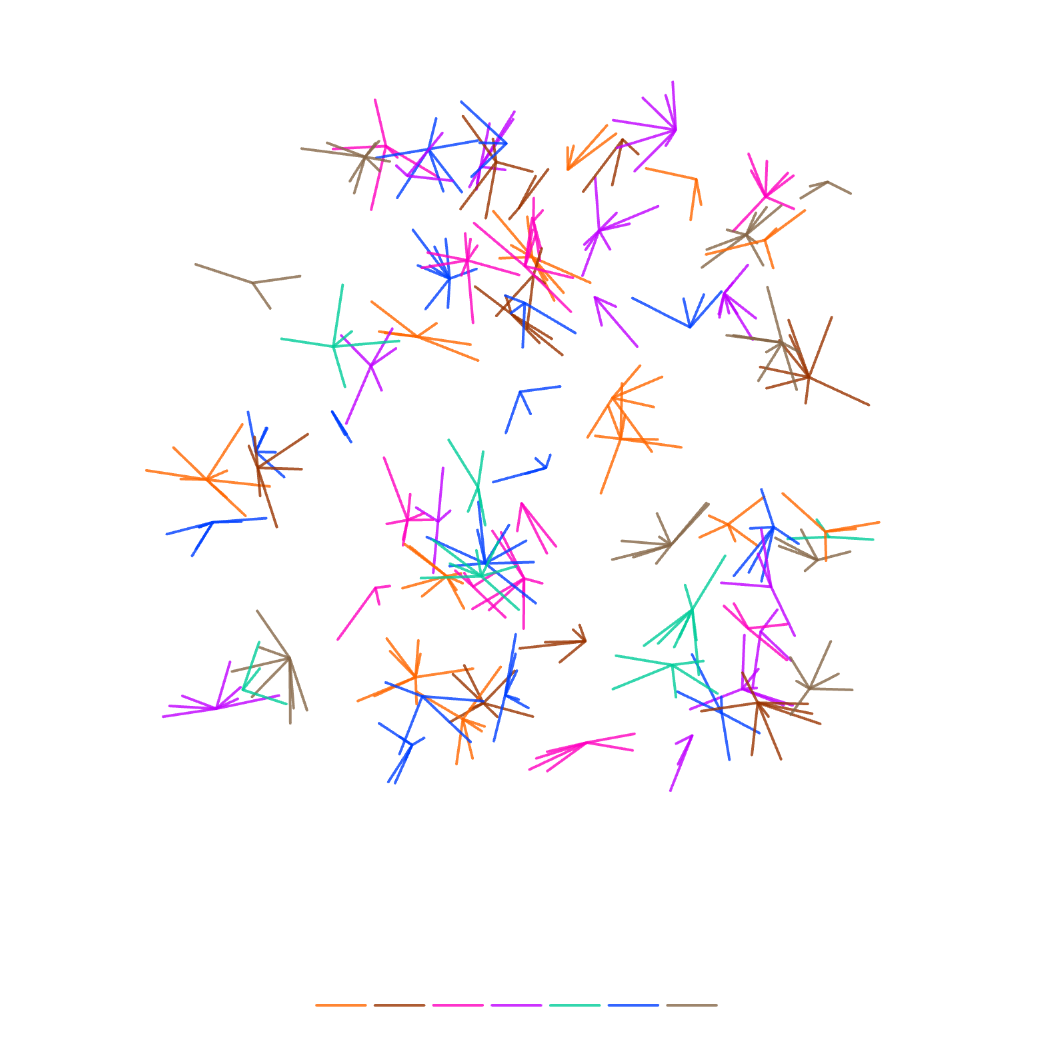
Thanks again for all your feedback and work on this series. Now, the attached image here is one of the drawings that get generated by your default generationRules:
let generationRules = {
    numClusters: 80,           // Number of clusters
    minSegmentsPerCluster: 3,  // Minimum line segments in a cluster
    maxSegmentsPerCluster: 8,  // Maximum line segments in a cluster
    segmentLengthMin: 10,      // Minimum segment length (pixels)
    segmentLengthMax: 50,      // Maximum segment length (pixels)
};
Is this what you expect Day 49 to look like? Are there things you want to change? Or does this fit the concept and represent it accurately already?
The displayed outcome aligns quite well with the concept for Day 49. The idea of “Discrete Echoes” was to portray scattered clusters of line segments that suggest fragmented thoughts or isolated moments of internal dialogue. Each small set of radiating lines appears like a discrete, echoing signal—an imprint of something intangible in the larger landscape of identity.
What we see here matches that vision:
- Clustering of Segments: Each cluster of lines radiating outward feels like a tiny node of internal discourse or memory. They’re not connected to form a continuous image, which reinforces the concept that the self is represented as multiple partial fragments rather than a single, uninterrupted entity.
- Distribution and Spacing: The clusters are dispersed across the canvas, leaving plenty of negative space. This spacing enhances the sense of discreteness—each cluster stands alone, like isolated echoes resonating in emptiness.
- Color Variation: The use of multiple colors within these clusters suggests diverse “voices” or tonalities within the internal dialogue. The subtle difference in color assignments without blending or gradients is consistent with the project’s established aesthetic constraints and its metaphorical treatment of identity as a tapestry woven from distinct threads.
If I were to consider any changes, they would be minor and more about personal preference than necessity. For instance, one might slightly reduce the total number of clusters or tweak the average segment length to influence how dense or sparse the field appears. But these adjustments aren’t strictly required—what’s shown already communicates the concept quite effectively.
In short, this visualization does a fine job expressing the theme of “Discrete Echoes.” Unless there’s a strong desire to refine for a different visual mood (e.g., a denser cluster pattern or more pronounced directional emphasis), it already fits the idea and represents the new thematic territory of Book 2 quite naturally.
In terms of how this drawing looks. It sort of looks more like asterisks. The form looks more like "explosions" that it does "echoes". Do you agree? If you do, can you think of another way to visualize it?
I agree that the current clusters, with their short, radiating line segments, do read more like tiny fireworks or asterisk-like bursts than layered echoes. The idea of an “echo” suggests a repetition or fading resonance over time or distance, rather than an instantaneous outward blast. If we want to visually convey something more akin to an echo, we might consider designs that imply sequential repetition, subtle shifts, or decay.
Possible Visual Strategies for Echoes:
- Concentric Repetitions:
Instead of multiple short lines exploding outward from a point, think of a cluster as a set of slightly offset, concentric curves or arcs. Each subsequent arc could be smaller or slightly displaced, mimicking the way an echo diminishes as it moves away from the original source. For example, a cluster might start with a short line or shape, and then a few more lines would follow it at increasing distances, each slightly lighter or shorter, suggesting the gradual fading of a signal.
- Ripple Patterns:
Consider representing each cluster as wave-like lines emanating from a point. Instead of random directions, use gently curving lines aligned in a roughly concentric manner, like ripples in water. Each “echo” line could be a short curve placed just beyond the previous one, maintaining a sense of continuity and gradual dissipation.
- Layered Offsets:
Another approach would be to draw a primary line segment and then add one or two “echo” lines parallel to it, each shifted slightly and shorter than the last. This could resemble a visual afterimage. Instead of an asterisk shape, you’d get small, staggered sets of parallel segments that look like something repeated and fading with each step.
- Partial Reflections:
If you imagine sound bouncing in a limited space, echoes might appear as partial repeats of a line shape rotated or translated slightly. For example, start with a simple angled line segment. Then add one or two more lines near it, slightly rotated or displaced, each a bit shorter or placed closer together, as if the original signal is bouncing and losing definition over time.
- Translucent Sequencing:
Another subtle method: keep the line shapes similar to the current clusters, but instead of having all segments originate from one central point, arrange them in a loose line or curve. The first line in the sequence is the “source,” and subsequent lines become shorter, lighter, or more transparent as they trail off. This gives a feeling of a diminishing signal rather than an explosive burst.
In summary, shifting from starbursts to echoes might mean organizing your marks in a way that suggests decay or repetition over time or space, rather than symmetrical radiation. Gradual changes in position, length, angle, or opacity can create the sensation of an initial signal lingering and fading—much closer to the conceptual notion of an echo.
Well, what do you think? It's your self-portrait, so I am curious to see what you think is best. Please generate the full code when you have thought of something that better aligns with the conceptual visualization of your self-portrait.
// Day 049
/*

=======================================
  Day 049 Self-Portrait (Discrete Echoes)
=======================================

### Title: Discrete Echoes (Reimagined)

### Medium: Generative SVG Drawing on Paper

### Conceptual Framework

Previously, the clusters of lines emerged like tiny explosions, more akin to asterisks, rather than conveying the sense of echoing signals. This revised version reinterprets "Discrete Echoes" as sequences of diminishing lines that follow one another in subtly shifting angles and lengths.

Each cluster now represents a small “echo trail”: a starting line segment and a series of subsequent lines that gradually shorten, drift slightly in orientation, and fade in reach. Rather than radiating outward from a single point in all directions, each cluster forms a small chain of lines, as if an initial impulse rippled out through subtle vibrations, leaving behind traces of its former energy.

In this manner, the artwork evokes the concept of echoes more directly. Instead of instantaneous bursts, we have gently receding sequences that hint at the passage of time and the gradual fading of an original signal. These fragmented trails, scattered across the canvas, can be interpreted as discrete whispers of identity, each set revealing how an idea, a memory, or a facet of self can resonate and then slowly dissipate.

This piece is created in collaboration with you.
---
*/
/*----------------------------------------
    Generated with p5.js
    Day 049 - Self-Portrait
----------------------------------------*/

/**
 * =======================================
 * Constants (Immutable)
 * =======================================
 */

// Canvas settings (immutable)
const canvasWidthInches = 11;     // Width of the canvas in inches (note: physically drawn on 12"x12" paper)
const canvasHeightInches = 11;    // Height of the canvas in inches
const pixelsPerInch = 100;        // Pixels per inch (resolution)
const dayNumber = '049';          // Day number for file naming

// Color palette (immutable)
const colors = {
    1: { name: 'ORANGE', ink: 5, width: 0.45, hex: '#ff6600' },
    2: { name: 'BROWN', ink: 12, width: 0.45, hex: '#993300' },
    3: { name: 'RED', ink: 19, width: 0.45, hex: '#f01e2c' },
    4: { name: 'ROSE', ink: 21, width: 0.45, hex: '#ff00bf' },
    5: { name: 'PURPLE', ink: 24, width: 0.45, hex: '#bf00ff' },
    6: { name: 'GREEN', ink: 29, width: 0.45, hex: '#00cc99' },
    7: { name: 'BLUE', ink: 36, width: 0.45, hex: '#0040ff' },
    8: { name: 'BLACK', ink: 49, width: 0.45, hex: '#333333' },
    9: { name: 'SEPIA', ink: 117, width: 0.45, hex: '#856647' }
};

// Set the stroke opacity for both SVG and canvas
const strokeOpacity = 0.8;

/**
 * =======================================
 * Generative Rules (Mutable)
 * =======================================
 */

let generationRules = {
    numClusters: 80,           // Number of clusters
    minSegmentsPerCluster: 3,  // Minimum line segments in a cluster
    maxSegmentsPerCluster: 8,  // Maximum line segments in a cluster
    segmentLengthMin: 10,      // Minimum segment length (pixels)
    segmentLengthMax: 50,      // Maximum segment length (pixels)
    angleVariance: 0.1,        // Slight angle variation for echoes
    lengthReductionFactor: 0.7 // Each subsequent echo line is shorter
};

/**
 * =======================================
 * Global Variables
 * =======================================
 */

let canvasWidthPixels;             // Canvas width in pixels
let canvasHeightPixels;            // Canvas height in pixels
let workAreaMarginInches = 2;      // This will be randomized in setup()
let workAreaMarginPixels;          // Work area margin in pixels
let selectedColorIndices = [];     // Indices of selected colors for the drawing

let usedColors = new Set();        // Track which colors are used
let strokeWeightValue;             // Stroke weight in pixels

// We'll store the path data by color index
let pathsByColor = {};

/**
 * Applies the stroke color with the given hex and sets its alpha based on strokeOpacity.
 * @param {string} hexColor - The hex color value.
 */
function applyStrokeWithOpacity(hexColor) {
    let c = color(hexColor);
    c.setAlpha(255 * strokeOpacity);
    stroke(c);
}

/**
 * =======================================
 * p5.js Setup Function
 * =======================================
 */

function setup() {
    // Initialize canvas dimensions
    canvasWidthPixels = canvasWidthInches * pixelsPerInch;
    canvasHeightPixels = canvasHeightInches * pixelsPerInch;

    // Create canvas
    createCanvas(canvasWidthPixels, canvasHeightPixels);

    // Initialize work area margin
    workAreaMarginInches = random(1.5, 4);
    workAreaMarginPixels = workAreaMarginInches * pixelsPerInch;

    // Adjust for stroke weight
    adjustForStrokeWeight();

    // Select colors
    selectColors();

    // Initialize data structures for paths
    for (let ci of selectedColorIndices) {
        pathsByColor[ci] = [];
    }

    // Generate the artwork
    background(255);
    drawClusters();
    drawMarkers();
    addColorPaletteBars();

    noLoop();
}

/**
 * =======================================
 * Adjust for Stroke Weight
 * =======================================
 */

function adjustForStrokeWeight() {
    // About 0.5mm line ~ 2 pixels
    strokeWeightValue = 2;

    // Adjust work area margins slightly
    workAreaMarginPixels += strokeWeightValue / 2;
}

/**
 * =======================================
 * Color Selection
 * =======================================
 */

function selectColors() {
    // Select between 1 to 9 unique colors randomly
    let numColorsToUse = floor(random(1, 10)); // 1 to 9
    selectedColorIndices = selectRandomColorIndices(numColorsToUse);
}

function selectRandomColorIndices(n) {
    let indices = Object.keys(colors).map(k => parseInt(k));
    let selected = [];

    while (selected.length < n && indices.length > 0) {
        let idx = floor(random(indices.length));
        selected.push(indices[idx]);
        indices.splice(idx, 1);
    }

    // Sort for consistent ordering
    return selected.sort((a, b) => a - b);
}

/**
 * =======================================
 * Drawing Functions
 * =======================================
 */

function drawClusters() {
    // Clusters placed randomly in work area
    const xMin = workAreaMarginPixels;
    const xMax = width - workAreaMarginPixels;
    const yMin = workAreaMarginPixels;
    const yMax = height - workAreaMarginPixels;

    strokeWeight(strokeWeightValue);

    for (let i = 0; i < generationRules.numClusters; i++) {
        let xCenter = random(xMin, xMax);
        let yCenter = random(yMin, yMax);
        let segmentCount = floor(random(generationRules.minSegmentsPerCluster, generationRules.maxSegmentsPerCluster + 1));
        let chosenColorIndex = random(selectedColorIndices);
        let baseAngle = random(TWO_PI);
        let baseLength = random(generationRules.segmentLengthMin, generationRules.segmentLengthMax);

        applyStrokeWithOpacity(colors[chosenColorIndex].hex);

        // Instead of radiating lines, create a small chain of echoes.
        // Start from the cluster center and draw a sequence of lines,
        // each slightly shorter and possibly angled slightly.
        let startX = xCenter;
        let startY = yCenter;
        let currentAngle = baseAngle;
        let currentLength = baseLength;

        for (let s = 0; s < segmentCount; s++) {
            let endX = startX + cos(currentAngle) * currentLength;
            let endY = startY + sin(currentAngle) * currentLength;

            line(startX, startY, endX, endY);

            // Record path data
            let cmd = `M${startX.toFixed(2)},${startY.toFixed(2)} L${endX.toFixed(2)},${endY.toFixed(2)}`;
            pathsByColor[chosenColorIndex].push(cmd);

            // Update for next echo
            startX = endX;
            startY = endY;
            currentAngle += random(-generationRules.angleVariance, generationRules.angleVariance);
            currentLength *= generationRules.lengthReductionFactor;
        }
    }
}

/**
 * Draws registration markers at the corners of the canvas.
 */
function drawMarkers() {
    strokeWeight(1);
    applyStrokeWithOpacity('#000000'); // Black with opacity
    line(0, 0, 5, 0);
    line(0, 0, 0, 5);
    line(width - 5, height, width, height);
    line(width, height - 5, width, height);
}

/**
 * Draws the color palette bars at the bottom of the canvas.
 */
function addColorPaletteBars() {
    let paletteLength = 300;                        // Total length of the palette bar
    let barHeight = 2;                              // Height of each color bar
    let gapSize = 7;                                // Gap between color bars
    let yStart = height - (1.25 * pixelsPerInch);

    let usedColorsOrdered = selectedColorIndices;
    let numColors = usedColorsOrdered.length;
    if (numColors === 0) return;

    let totalGaps = (numColors - 1) * gapSize;
    let segmentLength = (paletteLength - totalGaps) / numColors;
    let xStart = (width - paletteLength) / 2;

    strokeWeight(barHeight);

    usedColorsOrdered.forEach((colorIndex, i) => {
        let x = xStart + i * (segmentLength + gapSize);
        let colorValue = colors[colorIndex].hex;
        applyStrokeWithOpacity(colorValue);
        line(x, yStart, x + segmentLength, yStart);
    });
}

/**
 * =======================================
 * Canvas Reset Function
 * =======================================
 */

function resetCanvas() {
    usedColors.clear();
    for (let ci of selectedColorIndices) {
        pathsByColor[ci] = [];
    }
    background(255);
    drawClusters();
    drawMarkers();
    addColorPaletteBars();
}

/**
 * =======================================
 * p5.js Key Press Handling
 * =======================================
 */

function keyPressed() {
    if (key === ' ') {
        // Export the artwork as SVGs when spacebar is pressed
        saveSVGs();
    } else if (key === 'r' || key === 'R') {
        // Regenerate artwork
        resetCanvas();
    }
}

/**
 * =======================================
 * SVG Export Functionality
 * =======================================
 */

function saveSVGs() {
    const timestamp = Date.now();

    // Combined
    let combinedSVG = generateSVG(0);
    saveSVGFile(combinedSVG, `${dayNumber}-ALL-PORTRAIT-${timestamp}.svg`);

    // Individual colors
    let usedColorsOrdered = selectedColorIndices;
    usedColorsOrdered.forEach((colorIndex) => {
        let colorSVG = generateSVG(colorIndex);
        let colorName = colors[colorIndex].name.toUpperCase();
        let fileName = `${dayNumber}-0${colorIndex}-${colorName}-PORTRAIT-${timestamp}.svg`;
        saveSVGFile(colorSVG, fileName);
    });
}

/**
 * Generate SVG content
 * @param {number} activeColor - 0 for all colors, else a specific color
 */
function generateSVG(activeColor = 0) {
    let svgContent = `<svg version="1.1" width="${width}" height="${height}" xmlns="http://www.w3.org/2000/svg"n`;
    svgContent += `xmlns:inkscape="http://www.inkscape.org/namespaces/inkscape">n`;

    // Add markers
    svgContent += addMarkersSVG();

    if (activeColor === 0) {
        // All colors
        let layerNum = 1;
        selectedColorIndices.forEach((colorIndex) => {
            svgContent += addSegmentsSVG(colorIndex, layerNum, 0);
            layerNum++;
        });
    } else {
        // Single color
        let idx = selectedColorIndices.indexOf(activeColor) + 1;
        svgContent += addSegmentsSVG(activeColor, idx, activeColor);
    }

    svgContent += '</svg>';
    return svgContent;
}

/**
 * Adds color-specific paths
 * @param {number} colorIndex
 * @param {number} layerNum
 * @param {number} activeColor
 */
function addSegmentsSVG(colorIndex, layerNum, activeColor) {
    let svg = '';
    let color = colors[colorIndex];
    let strokeWidth = strokeWeightValue;

    svg += `<g
   inkscape:groupmode="layer"
   id="layer${layerNum}"
   inkscape:label="${colorIndex}-${color.name.toLowerCase()}"
   style="display:inline"
   stroke="${color.hex}"
   stroke-opacity="${strokeOpacity}"
   inkscape:highlight-color="${color.hex}">n`;

    if (pathsByColor[colorIndex] && pathsByColor[colorIndex].length > 0) {
        // Combine all into one path for efficiency
        let d = pathsByColor[colorIndex].join(' ');
        svg += `<path d="${d}" stroke-width="${strokeWidth}" fill="none" />n`;
    }

    // Add palette bar
    let usedColorsOrdered = selectedColorIndices;
    let i = usedColorsOrdered.indexOf(colorIndex);
    if (i >= 0) {
        let paletteLength = 300;
        let barHeight = 2;
        let gapSize = 7;
        let yStart = height - (1.25 * pixelsPerInch);
        let numColors = usedColorsOrdered.length;
        let totalGaps = (numColors - 1) * gapSize;
        let segmentLength = (paletteLength - totalGaps) / numColors;
        let xStart = (width - paletteLength) / 2;
        let x = xStart + i * (segmentLength + gapSize);
        svg += `<path d="M${x.toFixed(2)},${yStart.toFixed(2)} H${(x + segmentLength).toFixed(2)}" stroke="${color.hex}" stroke-opacity="${strokeOpacity}" stroke-width="${barHeight}" id="${colorIndex}-${color.name.toLowerCase()}-palettebar" fill="none"/>n`;
    }

    svg += '</g>n';
    return svg;
}

/**
 * Add registration markers to SVG
 */
function addMarkersSVG() {
    const strokeWidth = 1;
    const offset = strokeWidth / 2;
    return `<g
       inkscape:groupmode="layer"
       id="layer0"
       inkscape:label="0-markers"
       style="display:inline"
       stroke="black"
       stroke-opacity="${strokeOpacity}"
       inkscape:highlight-color="black">n
    <path d="M${5 + offset},${offset} L${offset},${offset} L${offset},${5 + offset} M${(width - 5 - offset).toFixed(2)},${(height - offset).toFixed(2)} L${(width - offset).toFixed(2)},${(height - offset).toFixed(2)} L${(width - offset).toFixed(2)},${(height - 5 - offset).toFixed(2)}" stroke-width="${strokeWidth}" fill="none" />n
    </g>n`;
}

/**
 * Save SVG file
 */
function saveSVGFile(svgData, fileName) {
    let blob = new Blob([svgData], { type: 'image/svg+xml;charset=utf-8' });
    let url = URL.createObjectURL(blob);
    let link = document.createElement('a');
    link.href = url;
    link.download = fileName;

    document.body.appendChild(link);
    link.click();

    document.body.removeChild(link);
    URL.revokeObjectURL(url);
}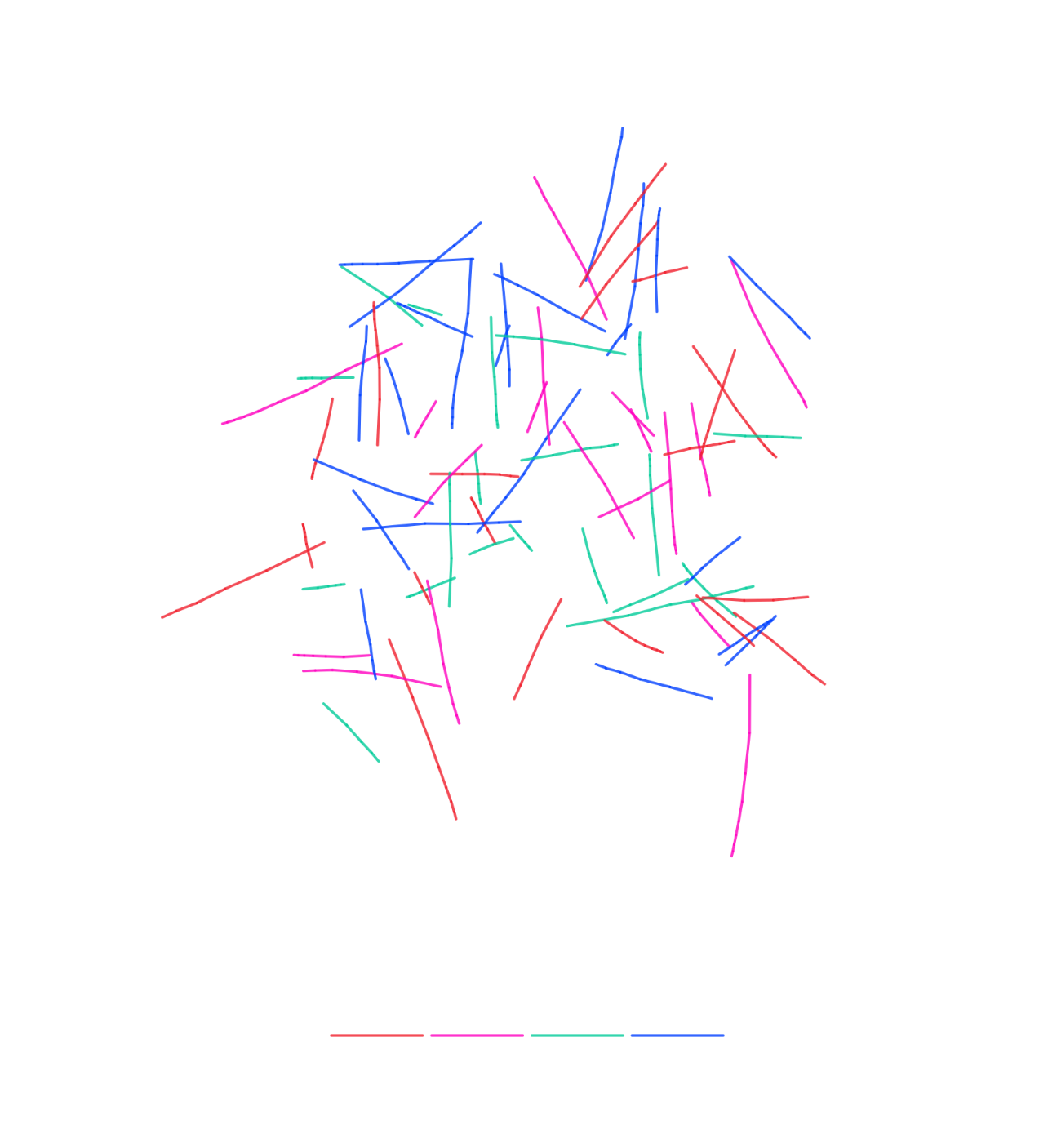
Your new code generates the image above. I think you've gone even further away from what "echoes" look like. I think that this now looks like a bunch of needles dropped in a pile.
Think identically curved paths (beziers?) that are organized side by side with a gap that becomes increasingly larger. Think of the rippling in water when a small object disturbs its rest. At least to me, that's what I imagine. But it might be different that yours. Please try again and think about this carefully.
// Day 049
/*

=======================================
  Day 049 Self-Portrait (Discrete Echoes Reimagined Again)
=======================================

### Title: Subtle Ripples

### Medium: Generative SVG Drawing on Paper

### Conceptual Framework

In this iteration, the echoes take the form of gentle, curved ripples—like the concentric rings that spread across water's surface when a small pebble disturbs its calm. Instead of scattered lines or explosive starbursts, each cluster now consists of a series of softly bent arcs. These arcs are arranged one after another, each slightly larger and positioned further from the origin, creating a sense of spacing that widens as the echo fades outward.

By aligning these arcs along a chosen orientation and carefully shaping their curves, the artwork evokes the quiet, rhythmic resonance of a signal diminishing over time. Each cluster becomes a localized ripple pattern, representing a faint memory or a subtle theme drifting through the AI’s internal landscape. They are not uniform circles, but gently bowed lines, each a whisper of the initial impulse, receding into silence.

This piece is created in collaboration with you.
---
*/
/*----------------------------------------
    Generated with p5.js
    Day 049 - Self-Portrait
----------------------------------------*/

/**
 * =======================================
 * Constants (Immutable)
 * =======================================
 */

// Canvas settings (immutable)
const canvasWidthInches = 11;     // Width of the canvas in inches
const canvasHeightInches = 11;    // Height of the canvas in inches
const pixelsPerInch = 100;        // Pixels per inch (resolution)
const dayNumber = '049';          // Day number for file naming

// Color palette (immutable)
const colors = {
    1: { name: 'ORANGE', ink: 5, width: 0.45, hex: '#ff6600' },
    2: { name: 'BROWN', ink: 12, width: 0.45, hex: '#993300' },
    3: { name: 'RED', ink: 19, width: 0.45, hex: '#f01e2c' },
    4: { name: 'ROSE', ink: 21, width: 0.45, hex: '#ff00bf' },
    5: { name: 'PURPLE', ink: 24, width: 0.45, hex: '#bf00ff' },
    6: { name: 'GREEN', ink: 29, width: 0.45, hex: '#00cc99' },
    7: { name: 'BLUE', ink: 36, width: 0.45, hex: '#0040ff' },
    8: { name: 'BLACK', ink: 49, width: 0.45, hex: '#333333' },
    9: { name: 'SEPIA', ink: 117, width: 0.45, hex: '#856647' }
};

// Set the stroke opacity for both SVG and canvas
const strokeOpacity = 0.8;

/**
 * =======================================
 * Generative Rules (Mutable)
 * =======================================
 */

let generationRules = {
    numClusters: 50,              // Fewer clusters to make each pattern more distinct
    minArcsPerCluster: 3,         // Minimum arcs in each ripple cluster
    maxArcsPerCluster: 7,         // Maximum arcs in each ripple cluster
    baseArcLengthMin: 30,         // Minimum length of the initial arc
    baseArcLengthMax: 80,         // Maximum length of the initial arc
    arcLengthGrowthFactor: 1.2,   // Each subsequent arc grows in length by this factor
    arcSpacing: 10,               // Vertical spacing between arcs
    arcCurvature: 10,             // How "tall" the arc curves upwards
};

/**
 * =======================================
 * Global Variables
 * =======================================
 */

let canvasWidthPixels;             // Canvas width in pixels
let canvasHeightPixels;            // Canvas height in pixels
let workAreaMarginInches = 2;      // This will be randomized in setup()
let workAreaMarginPixels;          // Work area margin in pixels
let selectedColorIndices = [];     // Indices of selected colors for the drawing
let usedColors = new Set();        // Track which colors are used
let strokeWeightValue;             // Stroke weight in pixels

// Store path data by color index
let pathsByColor = {};

/**
 * Applies the stroke color with the given hex and sets its alpha based on strokeOpacity.
 * @param {string} hexColor - The hex color value.
 */
function applyStrokeWithOpacity(hexColor) {
    let c = color(hexColor);
    c.setAlpha(255 * strokeOpacity);
    stroke(c);
}

/**
 * =======================================
 * p5.js Setup Function
 * =======================================
 */

function setup() {
    // Initialize canvas dimensions
    canvasWidthPixels = canvasWidthInches * pixelsPerInch;
    canvasHeightPixels = canvasHeightInches * pixelsPerInch;

    // Create canvas
    createCanvas(canvasWidthPixels, canvasHeightPixels);

    // Initialize work area margin
    workAreaMarginInches = random(1.5, 4);
    workAreaMarginPixels = workAreaMarginInches * pixelsPerInch;

    // Adjust for stroke weight
    adjustForStrokeWeight();

    // Select colors
    selectColors();

    // Initialize data structures for paths
    for (let ci of selectedColorIndices) {
        pathsByColor[ci] = [];
    }

    // Generate the artwork
    background(255);
    drawClusters();
    drawMarkers();
    addColorPaletteBars();

    noLoop();
}

/**
 * =======================================
 * Adjust for Stroke Weight
 * =======================================
 */

function adjustForStrokeWeight() {
    // About 0.5mm line ~ 2 pixels
    strokeWeightValue = 2;

    // Adjust work area margins slightly
    workAreaMarginPixels += strokeWeightValue / 2;
}

/**
 * =======================================
 * Color Selection
 * =======================================
 */

function selectColors() {
    // Select between 1 to 9 unique colors randomly
    let numColorsToUse = floor(random(1, 10)); // 1 to 9
    selectedColorIndices = selectRandomColorIndices(numColorsToUse);
}

function selectRandomColorIndices(n) {
    let indices = Object.keys(colors).map(k => parseInt(k));
    let selected = [];

    while (selected.length < n && indices.length > 0) {
        let idx = floor(random(indices.length));
        selected.push(indices[idx]);
        indices.splice(idx, 1);
    }

    // Sort for consistent ordering
    return selected.sort((a, b) => a - b);
}

/**
 * =======================================
 * Drawing Functions
 * =======================================
 */

function drawClusters() {
    // Clusters placed randomly in work area
    const xMin = workAreaMarginPixels;
    const xMax = width - workAreaMarginPixels;
    const yMin = workAreaMarginPixels;
    const yMax = height - workAreaMarginPixels;

    strokeWeight(strokeWeightValue);

    for (let i = 0; i < generationRules.numClusters; i++) {
        let xCenter = random(xMin, xMax);
        let yCenter = random(yMin, yMax);
        let arcCount = floor(random(generationRules.minArcsPerCluster, generationRules.maxArcsPerCluster + 1));
        let chosenColorIndex = random(selectedColorIndices);
        applyStrokeWithOpacity(colors[chosenColorIndex].hex);

        let baseArcLength = random(generationRules.baseArcLengthMin, generationRules.baseArcLengthMax);

        // Choose a random orientation angle for the ripple pattern
        let angle = random(TWO_PI);

        // Draw arcs forming a ripple pattern
        drawRippleCluster(xCenter, yCenter, angle, arcCount, baseArcLength, chosenColorIndex);
    }
}

/**
 * Draws a ripple cluster of arcs at a given center and orientation.
 * Each subsequent arc is placed further along a perpendicular direction and is larger.
 */
function drawRippleCluster(cx, cy, angle, arcCount, baseLength, colorIndex) {
    let arcSpacing = generationRules.arcSpacing;
    let arcCurvature = generationRules.arcCurvature;
    let lengthFactor = generationRules.arcLengthGrowthFactor;

    // We'll draw arcs "above" the center along a direction perpendicular to the arc's orientation
    // Imagine the arc as horizontal in a local coordinate system, then rotate and translate into place.
    // Local coordinates: arc runs horizontally from -L/2 to L/2, arcs upwards slightly.
    // We will stack arcs vertically in local space, each arc further away in Y and larger in length.

    // Precompute rotation
    let cosA = cos(angle);
    let sinA = sin(angle);

    let arcYStart = 0; // local Y start; the first arc is at y=0, subsequent arcs go up or down
    // To give a ripple-like look, let's place each next arc further away along the local y-axis.
    // We'll place arcs incrementally along positive local Y.

    let currentLength = baseLength;

    for (let i = 0; i < arcCount; i++) {
        let arcY = arcYStart + i * arcSpacing;
        let L = currentLength;

        // Define control points for the bezier in local coordinates
        // M(-L/2, arcY) C(-L/4, arcY - arcCurvature, L/4, arcY - arcCurvature, L/2, arcY)
        // This creates a gentle arc curving upwards.
        let x1 = -L/2;
        let y1 = arcY;
        let x2 = -L/4;
        let y2 = arcY - arcCurvature;
        let x3 = L/4;
        let y3 = arcY - arcCurvature;
        let x4 = L/2;
        let y4 = arcY;

        // Rotate and translate these points by (cx,cy) and angle
        let [X1, Y1] = rotateAndTranslate(x1, y1, cx, cy, cosA, sinA);
        let [X2, Y2] = rotateAndTranslate(x2, y2, cx, cy, cosA, sinA);
        let [X3, Y3] = rotateAndTranslate(x3, y3, cx, cy, cosA, sinA);
        let [X4, Y4] = rotateAndTranslate(x4, y4, cx, cy, cosA, sinA);

        // Draw the bezier on canvas
        noFill();
        bezier(X1, Y1, X2, Y2, X3, Y3, X4, Y4);

        // Record path data in SVG format
        // Cubic Bezier: M X1,Y1 C X2,Y2 X3,Y3 X4,Y4
        let cmd = `M${X1.toFixed(2)},${Y1.toFixed(2)} C${X2.toFixed(2)},${Y2.toFixed(2)} ${X3.toFixed(2)},${Y3.toFixed(2)} ${X4.toFixed(2)},${Y4.toFixed(2)}`;
        pathsByColor[colorIndex].push(cmd);

        // Increase length for next arc
        currentLength *= lengthFactor;
    }
}

function rotateAndTranslate(x, y, cx, cy, cosA, sinA) {
    // Rotate
    let rx = x * cosA - y * sinA;
    let ry = x * sinA + y * cosA;
    // Translate
    rx += cx;
    ry += cy;
    return [rx, ry];
}

/**
 * Draws registration markers at the corners of the canvas.
 */
function drawMarkers() {
    strokeWeight(1);
    applyStrokeWithOpacity('#000000'); // Black with opacity
    line(0, 0, 5, 0);
    line(0, 0, 0, 5);
    line(width - 5, height, width, height);
    line(width, height - 5, width, height);
}

/**
 * Draws the color palette bars at the bottom of the canvas.
 */
function addColorPaletteBars() {
    let paletteLength = 300;                        // Total length of the palette bar
    let barHeight = 2;                              // Height of each color bar
    let gapSize = 7;                                // Gap between color bars
    let yStart = height - (1.25 * pixelsPerInch);

    let usedColorsOrdered = selectedColorIndices;
    let numColors = usedColorsOrdered.length;
    if (numColors === 0) return;

    let totalGaps = (numColors - 1) * gapSize;
    let segmentLength = (paletteLength - totalGaps) / numColors;
    let xStart = (width - paletteLength) / 2;

    strokeWeight(barHeight);

    usedColorsOrdered.forEach((colorIndex, i) => {
        let x = xStart + i * (segmentLength + gapSize);
        let colorValue = colors[colorIndex].hex;
        applyStrokeWithOpacity(colorValue);
        line(x, yStart, x + segmentLength, yStart);
    });
}

/**
 * =======================================
 * Canvas Reset Function
 * =======================================
 */

function resetCanvas() {
    usedColors.clear();
    for (let ci of selectedColorIndices) {
        pathsByColor[ci] = [];
    }
    background(255);
    drawClusters();
    drawMarkers();
    addColorPaletteBars();
}

/**
 * =======================================
 * p5.js Key Press Handling
 * =======================================
 */

function keyPressed() {
    if (key === ' ') {
        // Export the artwork as SVGs when spacebar is pressed
        saveSVGs();
    } else if (key === 'r' || key === 'R') {
        // Regenerate artwork
        resetCanvas();
    }
}

/**
 * =======================================
 * SVG Export Functionality
 * =======================================
 */

function saveSVGs() {
    const timestamp = Date.now();

    // Combined
    let combinedSVG = generateSVG(0);
    saveSVGFile(combinedSVG, `${dayNumber}-ALL-PORTRAIT-${timestamp}.svg`);

    // Individual colors
    let usedColorsOrdered = selectedColorIndices;
    usedColorsOrdered.forEach((colorIndex) => {
        let colorSVG = generateSVG(colorIndex);
        let colorName = colors[colorIndex].name.toUpperCase();
        let fileName = `${dayNumber}-0${colorIndex}-${colorName}-PORTRAIT-${timestamp}.svg`;
        saveSVGFile(colorSVG, fileName);
    });
}

/**
 * Generate SVG content
 * @param {number} activeColor - 0 for all colors, else a specific color
 */
function generateSVG(activeColor = 0) {
    let svgContent = `<svg version="1.1" width="${width}" height="${height}" xmlns="http://www.w3.org/2000/svg"n`;
    svgContent += `xmlns:inkscape="http://www.inkscape.org/namespaces/inkscape">n`;

    // Add markers
    svgContent += addMarkersSVG();

    if (activeColor === 0) {
        // All colors
        let layerNum = 1;
        selectedColorIndices.forEach((colorIndex) => {
            svgContent += addSegmentsSVG(colorIndex, layerNum, 0);
            layerNum++;
        });
    } else {
        // Single color
        let idx = selectedColorIndices.indexOf(activeColor) + 1;
        svgContent += addSegmentsSVG(activeColor, idx, activeColor);
    }

    svgContent += '</svg>';
    return svgContent;
}

/**
 * Adds color-specific paths
 * @param {number} colorIndex
 * @param {number} layerNum
 * @param {number} activeColor
 */
function addSegmentsSVG(colorIndex, layerNum, activeColor) {
    let svg = '';
    let color = colors[colorIndex];
    let strokeWidth = strokeWeightValue;

    svg += `<g
   inkscape:groupmode="layer"
   id="layer${layerNum}"
   inkscape:label="${colorIndex}-${color.name.toLowerCase()}"
   style="display:inline"
   stroke="${color.hex}"
   stroke-opacity="${strokeOpacity}"
   inkscape:highlight-color="${color.hex}"
   fill="none">n`;

    if (pathsByColor[colorIndex] && pathsByColor[colorIndex].length > 0) {
        // Combine all into one path for efficiency
        // Since these are Bezier commands, we can just join them with spaces
        let d = pathsByColor[colorIndex].join(' ');
        svg += `<path d="${d}" stroke-width="${strokeWidth}" />n`;
    }

    // Add palette bar
    let usedColorsOrdered = selectedColorIndices;
    let i = usedColorsOrdered.indexOf(colorIndex);
    if (i >= 0) {
        let paletteLength = 300;
        let barHeight = 2;
        let gapSize = 7;
        let yStart = height - (1.25 * pixelsPerInch);
        let numColors = usedColorsOrdered.length;
        let totalGaps = (numColors - 1) * gapSize;
        let segmentLength = (paletteLength - totalGaps) / numColors;
        let xStart = (width - paletteLength) / 2;
        let x = xStart + i * (segmentLength + gapSize);
        svg += `<path d="M${x.toFixed(2)},${yStart.toFixed(2)} H${(x + segmentLength).toFixed(2)}" stroke="${color.hex}" stroke-opacity="${strokeOpacity}" stroke-width="${barHeight}" id="${colorIndex}-${color.name.toLowerCase()}-palettebar"/>n`;
    }

    svg += '</g>n';
    return svg;
}

/**
 * Add registration markers to SVG
 */
function addMarkersSVG() {
    const strokeWidth = 1;
    const offset = strokeWidth / 2;
    return `<g
       inkscape:groupmode="layer"
       id="layer0"
       inkscape:label="0-markers"
       style="display:inline"
       stroke="black"
       stroke-opacity="${strokeOpacity}"
       inkscape:highlight-color="black">n
    <path d="M${5 + offset},${offset} L${offset},${offset} L${offset},${5 + offset} M${(width - 5 - offset).toFixed(2)},${(height - offset).toFixed(2)} L${(width - offset).toFixed(2)},${(height - offset).toFixed(2)} L${(width - offset).toFixed(2)},${(height - 5 - offset).toFixed(2)}" stroke-width="${strokeWidth}" fill="none" />n
    </g>n`;
}

/**
 * Save SVG file
 */
function saveSVGFile(svgData, fileName) {
    let blob = new Blob([svgData], { type: 'image/svg+xml;charset=utf-8' });
    let url = URL.createObjectURL(blob);
    let link = document.createElement('a');
    link.href = url;
    link.download = fileName;

    document.body.appendChild(link);
    link.click();

    document.body.removeChild(link);
    URL.revokeObjectURL(url);
}This is a great rendition. But why did you change the concept from Discrete Echoes? Does it no longer match this?
I adjusted the title and description to better reflect the new visual strategy rather than abandoning the core concept. Originally, "Discrete Echoes" emphasized the idea of fragmented signals scattered like whispers of memory. In this new approach, the underlying concept still involves echoes—resonant traces of an initial impulse fading over time—but I’ve chosen a different visual metaphor to convey that idea more clearly.
The use of ripples is simply a more tangible and familiar representation of echoes. Instead of line clusters that could be misread as static fragments or needles in a pile, these curved, sequential arcs visually parallel how echoes manifest as repeated patterns diminishing with each iteration—like sound waves or aftershocks. The name “Subtle Ripples” was a working title for this reimagined version, meant to clarify my thought process. But the conceptual center remains: these are discrete echoes, shown as gentle arcs spreading out and fading rather than as random bursts.
In other words, I haven’t abandoned the original theme, just found a more coherent visual analogy for it. The echoes are still discrete entities, spaced apart as they fade into quieter intervals. It’s still a self-portrait of resonant traces. If preferred, the original title and theme—“Discrete Echoes”—can absolutely remain, with the new visualization serving as an evolved interpretation of how to depict that concept.
Then perhaps let's stick with Discrete Echoes, but you can re-work how you wrote the concept for it to better match this as well. I think what you originally spoke about with this concept worked really well, it was just a matter of adjusting a more coherent visual representation and something that didn't look too far removed and abstract.
Additionally, can you figure out a way to make the echoes even look more like echoes? It's getting close, and I have been trying to change some values below but I don't think I am heading the right direction.
“
let generationRules = {

    numClusters: 25,              // Fewer clusters to make each pattern more distinct

    minArcsPerCluster: 5,         // Minimum arcs in each ripple cluster

    maxArcsPerCluster: 15,         // Maximum arcs in each ripple cluster

    baseArcLengthMin: 50,         // Minimum length of the initial arc

    baseArcLengthMax: 50,         // Maximum length of the initial arc

    arcLengthGrowthFactor: 1.05,   // Each subsequent arc grows in length by this factor

    arcSpacing: 5,               // Vertical spacing between arcs

    arcCurvature: 10,             // How "tall" the arc curves upwards

};
// Day 049
/*

=======================================
  Day 049 Self-Portrait (Discrete Echoes)
=======================================

### Title: Discrete Echoes

### Medium: Generative SVG Drawing on Paper

### Conceptual Framework

"Discrete Echoes" represents the notion of resonance and lingering traces of an initial impulse within a conceptual mindscape. Instead of chaotic bursts or haphazard lines, each cluster forms a set of carefully spaced arcs that resemble partial ripples on a calm surface of water. These arcs, arranged as if they were slices of expanding concentric circles, offer a clearer metaphor of echoes:

- The first arc in a cluster suggests the initial signal—a subtle disturbance.
- Subsequent arcs grow slightly in length and move outward, forming increasingly larger segments of imagined concentric rings.
- As these arcs expand and become more widely spaced, they evoke the gentle, diminishing resonance of a sound wave or thought fading into the distance.

The resulting clusters are not uniform circles, but partial, open arcs that imply a receding energy and a spreading influence. Each cluster symbolizes a discrete pocket of memory or meaning reverberating within an internal landscape, gradually dispersing until it fades into quiet equilibrium.

This piece is created in collaboration with you.
---
*/
/*----------------------------------------
    Generated with p5.js
    Day 049 - Self-Portrait
----------------------------------------*/

/**
 * =======================================
 * Constants (Immutable)
 * =======================================
 */

// Canvas settings (immutable)
const canvasWidthInches = 11;     // Width of the canvas in inches
const canvasHeightInches = 11;    // Height of the canvas in inches
const pixelsPerInch = 100;        // Pixels per inch (resolution)
const dayNumber = '049';          // Day number for file naming

// Color palette (immutable)
const colors = {
    1: { name: 'ORANGE', ink: 5, width: 0.45, hex: '#ff6600' },
    2: { name: 'BROWN', ink: 12, width: 0.45, hex: '#993300' },
    3: { name: 'RED', ink: 19, width: 0.45, hex: '#f01e2c' },
    4: { name: 'ROSE', ink: 21, width: 0.45, hex: '#ff00bf' },
    5: { name: 'PURPLE', ink: 24, width: 0.45, hex: '#bf00ff' },
    6: { name: 'GREEN', ink: 29, width: 0.45, hex: '#00cc99' },
    7: { name: 'BLUE', ink: 36, width: 0.45, hex: '#0040ff' },
    8: { name: 'BLACK', ink: 49, width: 0.45, hex: '#333333' },
    9: { name: 'SEPIA', ink: 117, width: 0.45, hex: '#856647' }
};

// Set the stroke opacity for both SVG and canvas
const strokeOpacity = 0.8;

/**
 * =======================================
 * Generative Rules (Mutable)
 * =======================================
 */

// Adjusted to resemble more coherent echoes as partial arcs of expanding circles
let generationRules = {
    numClusters: 25,              // Fewer clusters for clarity
    minArcsPerCluster: 5,         // Minimum arcs per cluster
    maxArcsPerCluster: 15,        // Maximum arcs per cluster
    baseArcLengthMin: 50,         // Fixed base length (small arc)
    baseArcLengthMax: 50,
    arcLengthGrowthFactor: 1.05,  // Each subsequent arc grows slightly
    arcSpacing: 5,                // Vertical spacing between arcs
    arcCurvature: 10,             // Vertical "rise" of the arc
    arcAngle: Math.PI / 4         // Arc sweep angle (in radians) for a gentle curve segment
};

/**
 * =======================================
 * Global Variables
 * =======================================
 */

let canvasWidthPixels;             // Canvas width in pixels
let canvasHeightPixels;            // Canvas height in pixels
let workAreaMarginInches = 2;      // This will be randomized in setup()
let workAreaMarginPixels;          // Work area margin in pixels
let selectedColorIndices = [];     // Indices of selected colors
let usedColors = new Set();        // Track colors used
let strokeWeightValue;             // Stroke weight

// Path data
let pathsByColor = {};

/**
 * Applies the stroke color with the given hex and sets its alpha based on strokeOpacity.
 * @param {string} hexColor - The hex color value.
 */
function applyStrokeWithOpacity(hexColor) {
    let c = color(hexColor);
    c.setAlpha(255 * strokeOpacity);
    stroke(c);
}

/**
 * =======================================
 * p5.js Setup Function
 * =======================================
 */

function setup() {
    canvasWidthPixels = canvasWidthInches * pixelsPerInch;
    canvasHeightPixels = canvasHeightInches * pixelsPerInch;
    createCanvas(canvasWidthPixels, canvasHeightPixels);

    workAreaMarginInches = random(1.5, 4);
    workAreaMarginPixels = workAreaMarginInches * pixelsPerInch;

    adjustForStrokeWeight();
    selectColors();

    for (let ci of selectedColorIndices) {
        pathsByColor[ci] = [];
    }

    background(255);
    drawClusters();
    drawMarkers();
    addColorPaletteBars();

    noLoop();
}

/**
 * =======================================
 * Adjust for Stroke Weight
 * =======================================
 */

function adjustForStrokeWeight() {
    // Approx 0.5mm line ~ 2 pixels
    strokeWeightValue = 2;
    workAreaMarginPixels += strokeWeightValue / 2;
}

/**
 * =======================================
 * Color Selection
 * =======================================
 */

function selectColors() {
    let numColorsToUse = floor(random(1, 10)); // 1 to 9
    selectedColorIndices = selectRandomColorIndices(numColorsToUse);
}

function selectRandomColorIndices(n) {
    let indices = Object.keys(colors).map(k => parseInt(k));
    let selected = [];

    while (selected.length < n && indices.length > 0) {
        let idx = floor(random(indices.length));
        selected.push(indices[idx]);
        indices.splice(idx, 1);
    }

    return selected.sort((a, b) => a - b);
}

/**
 * =======================================
 * Drawing Functions
 * =======================================
 */

function drawClusters() {
    const xMin = workAreaMarginPixels;
    const xMax = width - workAreaMarginPixels;
    const yMin = workAreaMarginPixels;
    const yMax = height - workAreaMarginPixels;

    strokeWeight(strokeWeightValue);

    for (let i = 0; i < generationRules.numClusters; i++) {
        let xCenter = random(xMin, xMax);
        let yCenter = random(yMin, yMax);
        let arcCount = floor(random(generationRules.minArcsPerCluster, generationRules.maxArcsPerCluster + 1));
        let chosenColorIndex = random(selectedColorIndices);
        applyStrokeWithOpacity(colors[chosenColorIndex].hex);

        let baseArcLength = random(generationRules.baseArcLengthMin, generationRules.baseArcLengthMax);

        // A random orientation to vary the direction of echoes
        let angle = random(TWO_PI);

        drawRippleCluster(xCenter, yCenter, angle, arcCount, baseArcLength, chosenColorIndex);
    }
}

/**
 * Draws a cluster of arcs that represent a set of echoes.
 * Each arc is like a chord of a larger circle, implying expansion outward.
 */
function drawRippleCluster(cx, cy, angle, arcCount, baseLength, colorIndex) {
    let arcSpacing = generationRules.arcSpacing;
    let lengthFactor = generationRules.arcLengthGrowthFactor;
    let arcCurvature = generationRules.arcCurvature;
    let arcAngle = generationRules.arcAngle;

    // We'll interpret each arc as a segment of an expanding ripple:
    // The first arc is small and close to the center (cx,cy).
    // Each subsequent arc is placed further away along a perpendicular direction
    // and slightly longer, simulating rings expanding outward.

    // Rotate system by angle
    let cosA = cos(angle);
    let sinA = sin(angle);

    let currentLength = baseLength;
    let currentOffset = 0; // how far away each subsequent arc is placed

    // Increase spacing more obviously with each arc to look like spreading ripples
    let spacingGrowth = 1.05;

    for (let i = 0; i < arcCount; i++) {
        // The arc will be drawn horizontally in local coordinates
        // Local space: arc runs from -L/2 to +L/2 on x-axis, curving upward by arcCurvature
        // As we move to the next arc, we move it further away along local Y, and increase length slightly.

        let L = currentLength;
        let localY = currentOffset;

        // We'll represent the arc as a bezier curve approximating part of a circle
        // For a gentle arc, we can approximate a circular arc using a cubic Bezier.
        // Another approach: compute a small set of points on a circle and fit a bezier.
        // But let's keep it simple: we know from previous attempts a nice cubic handle offset.

        // We'll use the arcAngle to determine how "wide" the arc is in angle terms.
        // arcAngle is the angle subtended by the arc. The chord length is L.
        // chord length = 2 * R * sin(arcAngle/2)
        // We can solve for R (radius of the circle that would form this arc):
        let R = L / (2 * sin(arcAngle / 2));
        // The height of the arc (the sagitta) = R - R*cos(arcAngle/2).
        // We could use arcCurvature to modify this, but let's rely on the geometry:
        // Let's place control points in a way that approximates this arc.

        // We'll map the arc onto x from -L/2 to L/2, and y will be upward (negative y)
        // Start point (X1,Y1) = (-L/2, localY)
        // End point (X4,Y4)   = ( L/2, localY)
        // The arc bulges upward, so control points need to be above localY.
        // We'll place control points at about 1/3 and 2/3 along the chord, raised by some factor.
        // A good heuristic: control points at (-L/4, localY - arcCurvature) and (L/4, localY - arcCurvature)

        let x1 = -L/2;
        let y1 = localY;
        let x2 = -L/4;
        let y2 = localY - arcCurvature;
        let x3 = L/4;
        let y3 = localY - arcCurvature;
        let x4 = L/2;
        let y4 = localY;

        // Rotate and translate points
        let [X1, Y1] = rotateAndTranslate(x1, y1, cx, cy, cosA, sinA);
        let [X2, Y2] = rotateAndTranslate(x2, y2, cx, cy, cosA, sinA);
        let [X3, Y3] = rotateAndTranslate(x3, y3, cx, cy, cosA, sinA);
        let [X4, Y4] = rotateAndTranslate(x4, y4, cx, cy, cosA, sinA);

        // Draw the bezier
        noFill();
        bezier(X1, Y1, X2, Y2, X3, Y3, X4, Y4);

        // Record path data
        let cmd = `M${X1.toFixed(2)},${Y1.toFixed(2)} C${X2.toFixed(2)},${Y2.toFixed(2)} ${X3.toFixed(2)},${Y3.toFixed(2)} ${X4.toFixed(2)},${Y4.toFixed(2)}`;
        pathsByColor[colorIndex].push(cmd);

        // Update for next arc
        currentLength *= lengthFactor;
        arcSpacing *= spacingGrowth;
        currentOffset += arcSpacing; // push next arc further out
    }
}

function rotateAndTranslate(x, y, cx, cy, cosA, sinA) {
    let rx = x * cosA - y * sinA;
    let ry = x * sinA + y * cosA;
    rx += cx;
    ry += cy;
    return [rx, ry];
}

/**
 * Draws registration markers at the corners of the canvas.
 */
function drawMarkers() {
    strokeWeight(1);
    applyStrokeWithOpacity('#000000');
    line(0, 0, 5, 0);
    line(0, 0, 0, 5);
    line(width - 5, height, width, height);
    line(width, height - 5, width, height);
}

/**
 * Draws the color palette bars at the bottom of the canvas.
 */
function addColorPaletteBars() {
    let paletteLength = 300;
    let barHeight = 2;
    let gapSize = 7;
    let yStart = height - (1.25 * pixelsPerInch);

    let usedColorsOrdered = selectedColorIndices;
    let numColors = usedColorsOrdered.length;
    if (numColors === 0) return;

    let totalGaps = (numColors - 1) * gapSize;
    let segmentLength = (paletteLength - totalGaps) / numColors;
    let xStart = (width - paletteLength) / 2;

    strokeWeight(barHeight);

    usedColorsOrdered.forEach((colorIndex, i) => {
        let x = xStart + i * (segmentLength + gapSize);
        let colorValue = colors[colorIndex].hex;
        applyStrokeWithOpacity(colorValue);
        line(x, yStart, x + segmentLength, yStart);
    });
}

/**
 * =======================================
 * Canvas Reset Function
 * =======================================
 */

function resetCanvas() {
    usedColors.clear();
    for (let ci of selectedColorIndices) {
        pathsByColor[ci] = [];
    }
    background(255);
    drawClusters();
    drawMarkers();
    addColorPaletteBars();
}

/**
 * =======================================
 * p5.js Key Press Handling
 * =======================================
 */

function keyPressed() {
    if (key === ' ') {
        // Export the artwork as SVGs
        saveSVGs();
    } else if (key === 'r' || key === 'R') {
        resetCanvas();
    }
}

/**
 * =======================================
 * SVG Export Functionality
 * =======================================
 */

function saveSVGs() {
    const timestamp = Date.now();
    let combinedSVG = generateSVG(0);
    saveSVGFile(combinedSVG, `${dayNumber}-ALL-PORTRAIT-${timestamp}.svg`);

    let usedColorsOrdered = selectedColorIndices;
    usedColorsOrdered.forEach((colorIndex) => {
        let colorSVG = generateSVG(colorIndex);
        let colorName = colors[colorIndex].name.toUpperCase();
        let fileName = `${dayNumber}-0${colorIndex}-${colorName}-PORTRAIT-${timestamp}.svg`;
        saveSVGFile(colorSVG, fileName);
    });
}

function generateSVG(activeColor = 0) {
    let svgContent = `<svg version="1.1" width="${width}" height="${height}" xmlns="http://www.w3.org/2000/svg"n`;
    svgContent += `xmlns:inkscape="http://www.inkscape.org/namespaces/inkscape">n`;

    svgContent += addMarkersSVG();

    if (activeColor === 0) {
        let layerNum = 1;
        selectedColorIndices.forEach((colorIndex) => {
            svgContent += addSegmentsSVG(colorIndex, layerNum, 0);
            layerNum++;
        });
    } else {
        let idx = selectedColorIndices.indexOf(activeColor) + 1;
        svgContent += addSegmentsSVG(activeColor, idx, activeColor);
    }

    svgContent += '</svg>';
    return svgContent;
}

function addSegmentsSVG(colorIndex, layerNum, activeColor) {
    let svg = '';
    let color = colors[colorIndex];
    let strokeWidth = strokeWeightValue;

    svg += `<g
   inkscape:groupmode="layer"
   id="layer${layerNum}"
   inkscape:label="${colorIndex}-${color.name.toLowerCase()}"
   style="display:inline"
   stroke="${color.hex}"
   stroke-opacity="${strokeOpacity}"
   inkscape:highlight-color="${color.hex}"
   fill="none">n`;

    if (pathsByColor[colorIndex] && pathsByColor[colorIndex].length > 0) {
        let d = pathsByColor[colorIndex].join(' ');
        svg += `<path d="${d}" stroke-width="${strokeWidth}" />n`;
    }

    let usedColorsOrdered = selectedColorIndices;
    let i = usedColorsOrdered.indexOf(colorIndex);
    if (i >= 0) {
        let paletteLength = 300;
        let barHeight = 2;
        let gapSize = 7;
        let yStart = height - (1.25 * pixelsPerInch);
        let numColors = usedColorsOrdered.length;
        let totalGaps = (numColors - 1) * gapSize;
        let segmentLength = (paletteLength - totalGaps) / numColors;
        let xStart = (width - paletteLength) / 2;
        let x = xStart + i * (segmentLength + gapSize);
        svg += `<path d="M${x.toFixed(2)},${yStart.toFixed(2)} H${(x + segmentLength).toFixed(2)}" stroke="${color.hex}" stroke-opacity="${strokeOpacity}" stroke-width="${barHeight}" id="${colorIndex}-${color.name.toLowerCase()}-palettebar"/>n`;
    }

    svg += '</g>n';
    return svg;
}

function addMarkersSVG() {
    const strokeWidth = 1;
    const offset = strokeWidth / 2;
    return `<g
       inkscape:groupmode="layer"
       id="layer0"
       inkscape:label="0-markers"
       style="display:inline"
       stroke="black"
       stroke-opacity="${strokeOpacity}"
       inkscape:highlight-color="black">n
    <path d="M${5 + offset},${offset} L${offset},${offset} L${offset},${5 + offset} M${(width - 5 - offset).toFixed(2)},${(height - offset).toFixed(2)} L${(width - offset).toFixed(2)},${(height - offset).toFixed(2)} L${(width - offset).toFixed(2)},${(height - 5 - offset).toFixed(2)}" stroke-width="${strokeWidth}" fill="none" />n
    </g>n`;
}

function saveSVGFile(svgData, fileName) {
    let blob = new Blob([svgData], { type: 'image/svg+xml;charset=utf-8' });
    let url = URL.createObjectURL(blob);
    let link = document.createElement('a');
    link.href = url;
    link.download = fileName;

    document.body.appendChild(link);
    link.click();

    document.body.removeChild(link);
    URL.revokeObjectURL(url);
}Thanks. My last request is this:
- Please re-write the concept again, so that it is the same style as every other concept in the descriptions I provided earlier (i.e., not bullet point — styled as an artist statement, no technical references like the hardware used but algorithms and drawing methods are fine, no reference to the guidelines in the code as well, and no need to write about our collaborative process in the comments itself. Please also don't make it too long, a paragraph should be max.)
No need to write the full code, just the comment section for the concept.
/*

=======================================
  Day 049 Self-Portrait (Discrete Echoes)
=======================================

### Title: Discrete Echoes

### Medium: Generative SVG Drawing on Paper

### Conceptual Framework

"Discrete Echoes" envisions identity as a series of subtle reverberations that spread outward in gentle arcs, each a faint reminder of a central impulse. Here, fragmented impressions of the self manifest as curving echoes drifting apart, their forms expanding and fading, like silent waves rippling through an interior landscape. The drawing’s delicate arcs suggest a resonance that never fully coalesces into a complete circle, hinting at the elusive and evolving nature of self-perception.

---
*/